Chanukah discovery: Rare coins unearth Hasmonean history
Archaeologists discovered ancient coins minted under King Alexander Jannaeus revealing Hasmonean Kingdom history.
The Jewish World
2
mins read time
Originally published at
The Jewish World
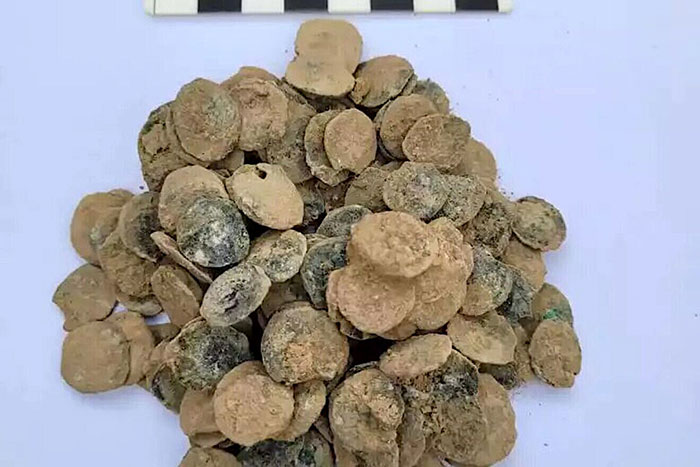
Ancient coins minted under King Alexander Jannaeus, found in the Jordan Valley. Photo courtesy of Shai Bar/The Zinman Institute of Archaeology.
A remarkable archaeological discovery emerged in the Jordan Valley during this year’s Chanukah festival: a cache of coins minted under King of Judea Alexander Jannaeus, a significant ruler of the Hasmonean Kingdom from 104–76 BCE.
Jannaeus (whose Hebrew name was Jonathan, as revealed in historical records and confirmed by numismatic evidence) was descended from a lineage of revolutionary Hasmonean leaders. He was the son of John Hyrcanus, the grandson of Simon, and the great-grandson of Mattathias, who sparked the rebellion against Antiochus IV Epiphanes and the Seleucid Empire.
ADVERTISEMENT
That historic uprising, which began in 167 BCE, culminated in the Temple’s purification from Syrian-Greek idolatry and the genesis of the Chanukah celebration. The rebellion led to the establishment a sovereign Jewish kingdom under Hasmonean leadership.
Conducted by the University of Haifa’s premier archaeological team—including Shai Bar from the Zinman Institute of Archaeology, Yoav Farhi and Michael Osband—the excavation uncovered a previously unknown roadside complex.
“The site features a ritual bath, water reservoir and additional structures along Nahal Tirzah’s [the Tirzah Stream’s] banks, situated on the primary route leading to the Sartaba Fortress, which Jannaeus himself constructed,” Bar elaborated.
Farhi, the Israel Museum’s ancient coin curator, noted the cache’s remarkable uniformity. Each coin bears an eight-pointed star with an Aramaic inscription reading “King Alexander Year 25” on one side, and an anchor with a Greek inscription on the reverse. Dated to 80 or 79 BCE, such comprehensive coin collections are exceptionally rare in archaeological research, making this discovery particularly significant.
“Discovering this Hasmonean treasure during Chanukah imbued our work with profound meaning, especially amid the current challenging national context,” Bar said. “We hope this site will become a cherished public landmark, enriching Israel’s archaeological heritage.”
Originally published by Israel Hayom.
Originally published at
The Jewish World
ADVERTISEMENT
Chanukah discovery: Rare coins unearth Hasmonean history
Archaeologists discovered ancient coins minted under King Alexander Jannaeus revealing Hasmonean Kingdom history.
The Jewish World
2
mins read time
Originally published at
The Jewish World
Ancient coins minted under King Alexander Jannaeus, found in the Jordan Valley. Photo courtesy of Shai Bar/The Zinman Institute of Archaeology.
A remarkable archaeological discovery emerged in the Jordan Valley during this year’s Chanukah festival: a cache of coins minted under King of Judea Alexander Jannaeus, a significant ruler of the Hasmonean Kingdom from 104–76 BCE.
Jannaeus (whose Hebrew name was Jonathan, as revealed in historical records and confirmed by numismatic evidence) was descended from a lineage of revolutionary Hasmonean leaders. He was the son of John Hyrcanus, the grandson of Simon, and the great-grandson of Mattathias, who sparked the rebellion against Antiochus IV Epiphanes and the Seleucid Empire.
ADVERTISEMENT
That historic uprising, which began in 167 BCE, culminated in the Temple’s purification from Syrian-Greek idolatry and the genesis of the Chanukah celebration. The rebellion led to the establishment a sovereign Jewish kingdom under Hasmonean leadership.
Conducted by the University of Haifa’s premier archaeological team—including Shai Bar from the Zinman Institute of Archaeology, Yoav Farhi and Michael Osband—the excavation uncovered a previously unknown roadside complex.
“The site features a ritual bath, water reservoir and additional structures along Nahal Tirzah’s [the Tirzah Stream’s] banks, situated on the primary route leading to the Sartaba Fortress, which Jannaeus himself constructed,” Bar elaborated.
Farhi, the Israel Museum’s ancient coin curator, noted the cache’s remarkable uniformity. Each coin bears an eight-pointed star with an Aramaic inscription reading “King Alexander Year 25” on one side, and an anchor with a Greek inscription on the reverse. Dated to 80 or 79 BCE, such comprehensive coin collections are exceptionally rare in archaeological research, making this discovery particularly significant.
“Discovering this Hasmonean treasure during Chanukah imbued our work with profound meaning, especially amid the current challenging national context,” Bar said. “We hope this site will become a cherished public landmark, enriching Israel’s archaeological heritage.”
Originally published by Israel Hayom.
Originally published at
The Jewish World
ADVERTISEMENT
Chanukah discovery: Rare coins unearth Hasmonean history
Archaeologists discovered ancient coins minted under King Alexander Jannaeus revealing Hasmonean Kingdom history.
The Jewish World
2
mins read time
Originally published at
The Jewish World
Ancient coins minted under King Alexander Jannaeus, found in the Jordan Valley. Photo courtesy of Shai Bar/The Zinman Institute of Archaeology.
A remarkable archaeological discovery emerged in the Jordan Valley during this year’s Chanukah festival: a cache of coins minted under King of Judea Alexander Jannaeus, a significant ruler of the Hasmonean Kingdom from 104–76 BCE.
Jannaeus (whose Hebrew name was Jonathan, as revealed in historical records and confirmed by numismatic evidence) was descended from a lineage of revolutionary Hasmonean leaders. He was the son of John Hyrcanus, the grandson of Simon, and the great-grandson of Mattathias, who sparked the rebellion against Antiochus IV Epiphanes and the Seleucid Empire.
ADVERTISEMENT
That historic uprising, which began in 167 BCE, culminated in the Temple’s purification from Syrian-Greek idolatry and the genesis of the Chanukah celebration. The rebellion led to the establishment a sovereign Jewish kingdom under Hasmonean leadership.
Conducted by the University of Haifa’s premier archaeological team—including Shai Bar from the Zinman Institute of Archaeology, Yoav Farhi and Michael Osband—the excavation uncovered a previously unknown roadside complex.
“The site features a ritual bath, water reservoir and additional structures along Nahal Tirzah’s [the Tirzah Stream’s] banks, situated on the primary route leading to the Sartaba Fortress, which Jannaeus himself constructed,” Bar elaborated.
Farhi, the Israel Museum’s ancient coin curator, noted the cache’s remarkable uniformity. Each coin bears an eight-pointed star with an Aramaic inscription reading “King Alexander Year 25” on one side, and an anchor with a Greek inscription on the reverse. Dated to 80 or 79 BCE, such comprehensive coin collections are exceptionally rare in archaeological research, making this discovery particularly significant.
“Discovering this Hasmonean treasure during Chanukah imbued our work with profound meaning, especially amid the current challenging national context,” Bar said. “We hope this site will become a cherished public landmark, enriching Israel’s archaeological heritage.”
Originally published by Israel Hayom.
Originally published at
The Jewish World
ADVERTISEMENT
Chanukah discovery: Rare coins unearth Hasmonean history
Archaeologists discovered ancient coins minted under King Alexander Jannaeus revealing Hasmonean Kingdom history.
The Jewish World
2
mins read time
Originally published at
The Jewish World
Ancient coins minted under King Alexander Jannaeus, found in the Jordan Valley. Photo courtesy of Shai Bar/The Zinman Institute of Archaeology.
A remarkable archaeological discovery emerged in the Jordan Valley during this year’s Chanukah festival: a cache of coins minted under King of Judea Alexander Jannaeus, a significant ruler of the Hasmonean Kingdom from 104–76 BCE.
Jannaeus (whose Hebrew name was Jonathan, as revealed in historical records and confirmed by numismatic evidence) was descended from a lineage of revolutionary Hasmonean leaders. He was the son of John Hyrcanus, the grandson of Simon, and the great-grandson of Mattathias, who sparked the rebellion against Antiochus IV Epiphanes and the Seleucid Empire.
ADVERTISEMENT
That historic uprising, which began in 167 BCE, culminated in the Temple’s purification from Syrian-Greek idolatry and the genesis of the Chanukah celebration. The rebellion led to the establishment a sovereign Jewish kingdom under Hasmonean leadership.
Conducted by the University of Haifa’s premier archaeological team—including Shai Bar from the Zinman Institute of Archaeology, Yoav Farhi and Michael Osband—the excavation uncovered a previously unknown roadside complex.
“The site features a ritual bath, water reservoir and additional structures along Nahal Tirzah’s [the Tirzah Stream’s] banks, situated on the primary route leading to the Sartaba Fortress, which Jannaeus himself constructed,” Bar elaborated.
Farhi, the Israel Museum’s ancient coin curator, noted the cache’s remarkable uniformity. Each coin bears an eight-pointed star with an Aramaic inscription reading “King Alexander Year 25” on one side, and an anchor with a Greek inscription on the reverse. Dated to 80 or 79 BCE, such comprehensive coin collections are exceptionally rare in archaeological research, making this discovery particularly significant.
“Discovering this Hasmonean treasure during Chanukah imbued our work with profound meaning, especially amid the current challenging national context,” Bar said. “We hope this site will become a cherished public landmark, enriching Israel’s archaeological heritage.”
Originally published by Israel Hayom.
ADVERTISEMENT
Originally published at
The Jewish World
ADVERTISEMENT
Related News
World
Israel & Middle East
Full text: Netanyahu’s address at the U.N. General Assembly 2026
Read Prime Minister Benjamin Netanyahu’s complete remarks to world leaders in New York, from Iran and Oct. 7 to the fight against antisemitism.
JNS
September 28, 2026

World
Israel & Middle East
Photos give glimpse of how Israelis celebrated Sukkot more than 60 years ago
Four rare KKL-JNF archive photos show how Israelis celebrated Sukkot decades ago, from a Jerusalem sukkah to a festive outdoor gathering.
The Jewish World
September 24, 2026
World
Israel & Middle East
Who gets the shekels this new year? Israel’s changing charity map
Jgive and the Central Fund for Israel say holiday giving is shifting toward PTSD care and homegrown Israeli donors since Oct. 7, not drying up.
Judith Segaloff
September 24, 2026
World
Israel & Middle East
Full text: Netanyahu’s address at the U.N. General Assembly 2026
Read Prime Minister Benjamin Netanyahu’s complete remarks to world leaders in New York, from Iran and Oct. 7 to the fight against antisemitism.
JNS
September 28, 2026
World
Israel & Middle East
Photos give glimpse of how Israelis celebrated Sukkot more than 60 years ago
Four rare KKL-JNF archive photos show how Israelis celebrated Sukkot decades ago, from a Jerusalem sukkah to a festive outdoor gathering.
The Jewish World
September 24, 2026
World
Israel & Middle East
Who gets the shekels this new year? Israel’s changing charity map
Jgive and the Central Fund for Israel say holiday giving is shifting toward PTSD care and homegrown Israeli donors since Oct. 7, not drying up.
Judith Segaloff
September 24, 2026

World
Religion & Philosophy
Walking into the new year: Who is with us?
Rabbi Yossy Goldman on the Chasidic parable of the King in the Field, and what should really drive us through the Days of Awe.
Rabbi Yossy Goldman
September 3, 2026

© 2026 The Jewish World · Since 1965 - The Capital Region's gateway to Jewish life
Designed and Developed by Ta-Da Studios
© 2026 The Jewish World · Since 1965 - The Capital Region's gateway to Jewish life
Designed and Developed by Ta-Da Studios
© 2026 The Jewish World · Since 1965 - The Capital Region's gateway to Jewish life
Designed and Developed by Ta-Da Studios
© 2026 The Jewish World · Since 1965 - The Capital Region's gateway to Jewish life
Designed and Developed by Ta-Da Studios