‘My Tree in Israel’: Another way to connect with Israel
A new ‘My Tree in Israel’ project allows diaspora Jews and non-Jews to adopt and visit olive trees, grapevines, or whisky casks as fundraising.
The Jewish World
5
mins read time
Originally published at
The Jewish World
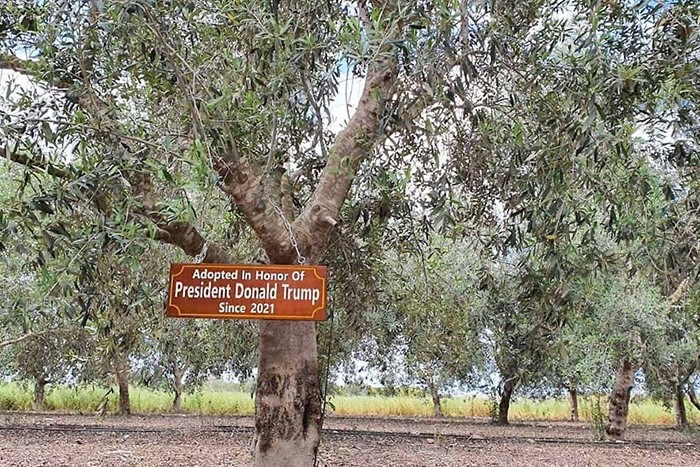
An olive tree adopted in honor of President Donald Trump at Moshav Hayogev, Aug. 4, 2025. Photo courtesy of Tal Marom.
When I was growing up in Long Island quite a few decades ago, a common bar mitzvah or bat mitzvah gift was a certificate stating that a tree had been planted in the boy’s or girl’s honor. It was often accompanied by a tongue-in-cheek card, saying, “Mazeltov! Your day to water your tree is Monday.”
Adoption /donation
In Israel today, it’s now possible to visit “your” tree as part of a new project called “My Tree in Israel” ([www.mytree.org.il](http://www.mytree.org.il)), which aims to connect both Jews and non-Jews abroad by “adopting” an olive tree, grapevine or whisky cask. The idea is not only a donation, but a way for participants to feel that they are partners in an Israeli business.
The largest program in “My Tree in Israel” is the olive grove on Moshav Hayogev in the Jezreel Valley in northern Israel, featuring some 2,200 trees of Barnea olives, which produce a particularly smooth olive oil.
Participants pay $250 a year, and in exchange get six bottles of extra-virgin olive oil made at the neighboring high-tech olive oil press, the largest in the Middle East, and shipped to homes all over the world. Participants can design their own labels and many use the olive oil as holiday gifts to friends and family.
Strengthen Israel connection
“The idea is to support Israel, and to strengthen connections with individual Israeli farmers,” Kobi Assaf, the founder and CEO, told JNS.
Many synagogues and churches had already adopted a group of trees, he said. Individuals can also adopt a tree and place a wooden plaque in honor of or in memory of someone special.
ADVERTISEMENT
Tributes and memorials
There are trees adopted in honor of U.S. President Donald Trump and U.S. Ambassador to Israel Mike Huckabee. A tree in memory of the Bibas family, Shiri and her two little red-headed boys, Kfir and Ariel, is due to be inaugurated soon.
There are also trees “adopted” in memory of fallen Israeli soldiers, including a 20-year-old special forces soldier named Reef Harush, who was killed fighting in Gaza in April 2024. Harush had been in the army just eight months and was supposed to still be in training for the elite Egoz unit, but was sent to Gaza because of the war.
On a recent scorching day, his father, Avi Harush, came to see the tree for the first time and said he had mixed feelings.
“I’m sure Reef is happy about it,” he told JNS. “He and his friends used to come to this area all the time because it is near our kibbutz. Reef was a person who loved and appreciated life.”
Yishai Gelb, the VP of marketing for “My Tree in Israel,” quoted one of his customers saying, “I feel like I have a piece of land in Israel and I’m so happy to share it with family and friends.” He added, “We want people to feel proud of Israel and to feel like they have a stake here.”
One can also “adopt” a grapevine at the Jezreel Valley Winery, which produces 80,000 bottles a year. Participants receive six bottles of wine shipped to them for a yearly fee of $360. There are several options available for different wines and, in the service of readers, I tasted two: a slightly off-dry Gewürztraminer and a Megiddo blend of Shiraz and Cabernet Sauvignon.
The Jezreel Valley Winery, founded in 2012, produces 80,000 bottles a year and is even served in several Michelin-star restaurants in Europe.
“We decided to use local grapes like shiraz, Carignan and argaman,” said Tal Raviv, one of the winemakers. “Our vision is to make wine with grapes that are growing here in this area, but most of our wine should be fun and tasty.”
Whisky too
The wines are shipped in time to arrive for Rosh Hashanah and Passover, when most of the kosher wine is consumed both in Israel and abroad. As with the olive oil, you can personalize the label and share your gift with friends and family.
If you’re not into olive oil or wine but like whisky, “My Tree in Israel” offers another option to invest in part of a whisky cask at the Golan Heights Distillery, founded by Canadian immigrants David and Alona Zibell, which makes Israel’s first 100 percent locally crafted whisky.
For an investment of $450, you receive six bottles of Golani Black Lifestyle Whisky, a single-grain whisky aged in charred barrels. As with the olive trees or grapevines, you are welcome to visit your whisky barrel (and do some tasting while you’re there).
Assaf said that about half of “My Tree in Israel” participants are Jews, including synagogues and JCCs, while the other half are evangelical Christians. Huckabee, the American ambassador, supports the initiative.
“My Tree in Israel” is helping the Avivim Winery, just a few hundred yards from the border with Lebanon, which was destroyed by a missile fired from Hezbollah.
At the winery, you can still see the charred equipment and glass crunches underfoot. Yisrael Biton, who runs the winery, says it managed to save 30,000 of the 300,000 bottles and several casks of wine. “My Tree in Israel” is helping to sell the wine while a new winery is under construction.
Originally published at
The Jewish World
ADVERTISEMENT
‘My Tree in Israel’: Another way to connect with Israel
A new ‘My Tree in Israel’ project allows diaspora Jews and non-Jews to adopt and visit olive trees, grapevines, or whisky casks as fundraising.
The Jewish World
5
mins read time
Originally published at
The Jewish World
An olive tree adopted in honor of President Donald Trump at Moshav Hayogev, Aug. 4, 2025. Photo courtesy of Tal Marom.
When I was growing up in Long Island quite a few decades ago, a common bar mitzvah or bat mitzvah gift was a certificate stating that a tree had been planted in the boy’s or girl’s honor. It was often accompanied by a tongue-in-cheek card, saying, “Mazeltov! Your day to water your tree is Monday.”
Adoption /donation
In Israel today, it’s now possible to visit “your” tree as part of a new project called “My Tree in Israel” ([www.mytree.org.il](http://www.mytree.org.il)), which aims to connect both Jews and non-Jews abroad by “adopting” an olive tree, grapevine or whisky cask. The idea is not only a donation, but a way for participants to feel that they are partners in an Israeli business.
The largest program in “My Tree in Israel” is the olive grove on Moshav Hayogev in the Jezreel Valley in northern Israel, featuring some 2,200 trees of Barnea olives, which produce a particularly smooth olive oil.
Participants pay $250 a year, and in exchange get six bottles of extra-virgin olive oil made at the neighboring high-tech olive oil press, the largest in the Middle East, and shipped to homes all over the world. Participants can design their own labels and many use the olive oil as holiday gifts to friends and family.
Strengthen Israel connection
“The idea is to support Israel, and to strengthen connections with individual Israeli farmers,” Kobi Assaf, the founder and CEO, told JNS.
Many synagogues and churches had already adopted a group of trees, he said. Individuals can also adopt a tree and place a wooden plaque in honor of or in memory of someone special.
ADVERTISEMENT
Tributes and memorials
There are trees adopted in honor of U.S. President Donald Trump and U.S. Ambassador to Israel Mike Huckabee. A tree in memory of the Bibas family, Shiri and her two little red-headed boys, Kfir and Ariel, is due to be inaugurated soon.
There are also trees “adopted” in memory of fallen Israeli soldiers, including a 20-year-old special forces soldier named Reef Harush, who was killed fighting in Gaza in April 2024. Harush had been in the army just eight months and was supposed to still be in training for the elite Egoz unit, but was sent to Gaza because of the war.
On a recent scorching day, his father, Avi Harush, came to see the tree for the first time and said he had mixed feelings.
“I’m sure Reef is happy about it,” he told JNS. “He and his friends used to come to this area all the time because it is near our kibbutz. Reef was a person who loved and appreciated life.”
Yishai Gelb, the VP of marketing for “My Tree in Israel,” quoted one of his customers saying, “I feel like I have a piece of land in Israel and I’m so happy to share it with family and friends.” He added, “We want people to feel proud of Israel and to feel like they have a stake here.”
One can also “adopt” a grapevine at the Jezreel Valley Winery, which produces 80,000 bottles a year. Participants receive six bottles of wine shipped to them for a yearly fee of $360. There are several options available for different wines and, in the service of readers, I tasted two: a slightly off-dry Gewürztraminer and a Megiddo blend of Shiraz and Cabernet Sauvignon.
The Jezreel Valley Winery, founded in 2012, produces 80,000 bottles a year and is even served in several Michelin-star restaurants in Europe.
“We decided to use local grapes like shiraz, Carignan and argaman,” said Tal Raviv, one of the winemakers. “Our vision is to make wine with grapes that are growing here in this area, but most of our wine should be fun and tasty.”
Whisky too
The wines are shipped in time to arrive for Rosh Hashanah and Passover, when most of the kosher wine is consumed both in Israel and abroad. As with the olive oil, you can personalize the label and share your gift with friends and family.
If you’re not into olive oil or wine but like whisky, “My Tree in Israel” offers another option to invest in part of a whisky cask at the Golan Heights Distillery, founded by Canadian immigrants David and Alona Zibell, which makes Israel’s first 100 percent locally crafted whisky.
For an investment of $450, you receive six bottles of Golani Black Lifestyle Whisky, a single-grain whisky aged in charred barrels. As with the olive trees or grapevines, you are welcome to visit your whisky barrel (and do some tasting while you’re there).
Assaf said that about half of “My Tree in Israel” participants are Jews, including synagogues and JCCs, while the other half are evangelical Christians. Huckabee, the American ambassador, supports the initiative.
“My Tree in Israel” is helping the Avivim Winery, just a few hundred yards from the border with Lebanon, which was destroyed by a missile fired from Hezbollah.
At the winery, you can still see the charred equipment and glass crunches underfoot. Yisrael Biton, who runs the winery, says it managed to save 30,000 of the 300,000 bottles and several casks of wine. “My Tree in Israel” is helping to sell the wine while a new winery is under construction.
Originally published at
The Jewish World
ADVERTISEMENT
‘My Tree in Israel’: Another way to connect with Israel
A new ‘My Tree in Israel’ project allows diaspora Jews and non-Jews to adopt and visit olive trees, grapevines, or whisky casks as fundraising.
The Jewish World
5
mins read time
Originally published at
The Jewish World
An olive tree adopted in honor of President Donald Trump at Moshav Hayogev, Aug. 4, 2025. Photo courtesy of Tal Marom.
When I was growing up in Long Island quite a few decades ago, a common bar mitzvah or bat mitzvah gift was a certificate stating that a tree had been planted in the boy’s or girl’s honor. It was often accompanied by a tongue-in-cheek card, saying, “Mazeltov! Your day to water your tree is Monday.”
Adoption /donation
In Israel today, it’s now possible to visit “your” tree as part of a new project called “My Tree in Israel” ([www.mytree.org.il](http://www.mytree.org.il)), which aims to connect both Jews and non-Jews abroad by “adopting” an olive tree, grapevine or whisky cask. The idea is not only a donation, but a way for participants to feel that they are partners in an Israeli business.
The largest program in “My Tree in Israel” is the olive grove on Moshav Hayogev in the Jezreel Valley in northern Israel, featuring some 2,200 trees of Barnea olives, which produce a particularly smooth olive oil.
Participants pay $250 a year, and in exchange get six bottles of extra-virgin olive oil made at the neighboring high-tech olive oil press, the largest in the Middle East, and shipped to homes all over the world. Participants can design their own labels and many use the olive oil as holiday gifts to friends and family.
Strengthen Israel connection
“The idea is to support Israel, and to strengthen connections with individual Israeli farmers,” Kobi Assaf, the founder and CEO, told JNS.
Many synagogues and churches had already adopted a group of trees, he said. Individuals can also adopt a tree and place a wooden plaque in honor of or in memory of someone special.
ADVERTISEMENT
Tributes and memorials
There are trees adopted in honor of U.S. President Donald Trump and U.S. Ambassador to Israel Mike Huckabee. A tree in memory of the Bibas family, Shiri and her two little red-headed boys, Kfir and Ariel, is due to be inaugurated soon.
There are also trees “adopted” in memory of fallen Israeli soldiers, including a 20-year-old special forces soldier named Reef Harush, who was killed fighting in Gaza in April 2024. Harush had been in the army just eight months and was supposed to still be in training for the elite Egoz unit, but was sent to Gaza because of the war.
On a recent scorching day, his father, Avi Harush, came to see the tree for the first time and said he had mixed feelings.
“I’m sure Reef is happy about it,” he told JNS. “He and his friends used to come to this area all the time because it is near our kibbutz. Reef was a person who loved and appreciated life.”
Yishai Gelb, the VP of marketing for “My Tree in Israel,” quoted one of his customers saying, “I feel like I have a piece of land in Israel and I’m so happy to share it with family and friends.” He added, “We want people to feel proud of Israel and to feel like they have a stake here.”
One can also “adopt” a grapevine at the Jezreel Valley Winery, which produces 80,000 bottles a year. Participants receive six bottles of wine shipped to them for a yearly fee of $360. There are several options available for different wines and, in the service of readers, I tasted two: a slightly off-dry Gewürztraminer and a Megiddo blend of Shiraz and Cabernet Sauvignon.
The Jezreel Valley Winery, founded in 2012, produces 80,000 bottles a year and is even served in several Michelin-star restaurants in Europe.
“We decided to use local grapes like shiraz, Carignan and argaman,” said Tal Raviv, one of the winemakers. “Our vision is to make wine with grapes that are growing here in this area, but most of our wine should be fun and tasty.”
Whisky too
The wines are shipped in time to arrive for Rosh Hashanah and Passover, when most of the kosher wine is consumed both in Israel and abroad. As with the olive oil, you can personalize the label and share your gift with friends and family.
If you’re not into olive oil or wine but like whisky, “My Tree in Israel” offers another option to invest in part of a whisky cask at the Golan Heights Distillery, founded by Canadian immigrants David and Alona Zibell, which makes Israel’s first 100 percent locally crafted whisky.
For an investment of $450, you receive six bottles of Golani Black Lifestyle Whisky, a single-grain whisky aged in charred barrels. As with the olive trees or grapevines, you are welcome to visit your whisky barrel (and do some tasting while you’re there).
Assaf said that about half of “My Tree in Israel” participants are Jews, including synagogues and JCCs, while the other half are evangelical Christians. Huckabee, the American ambassador, supports the initiative.
“My Tree in Israel” is helping the Avivim Winery, just a few hundred yards from the border with Lebanon, which was destroyed by a missile fired from Hezbollah.
At the winery, you can still see the charred equipment and glass crunches underfoot. Yisrael Biton, who runs the winery, says it managed to save 30,000 of the 300,000 bottles and several casks of wine. “My Tree in Israel” is helping to sell the wine while a new winery is under construction.
Originally published at
The Jewish World
ADVERTISEMENT
‘My Tree in Israel’: Another way to connect with Israel
A new ‘My Tree in Israel’ project allows diaspora Jews and non-Jews to adopt and visit olive trees, grapevines, or whisky casks as fundraising.
The Jewish World
5
mins read time
Originally published at
The Jewish World
An olive tree adopted in honor of President Donald Trump at Moshav Hayogev, Aug. 4, 2025. Photo courtesy of Tal Marom.
When I was growing up in Long Island quite a few decades ago, a common bar mitzvah or bat mitzvah gift was a certificate stating that a tree had been planted in the boy’s or girl’s honor. It was often accompanied by a tongue-in-cheek card, saying, “Mazeltov! Your day to water your tree is Monday.”
Adoption /donation
In Israel today, it’s now possible to visit “your” tree as part of a new project called “My Tree in Israel” ([www.mytree.org.il](http://www.mytree.org.il)), which aims to connect both Jews and non-Jews abroad by “adopting” an olive tree, grapevine or whisky cask. The idea is not only a donation, but a way for participants to feel that they are partners in an Israeli business.
The largest program in “My Tree in Israel” is the olive grove on Moshav Hayogev in the Jezreel Valley in northern Israel, featuring some 2,200 trees of Barnea olives, which produce a particularly smooth olive oil.
Participants pay $250 a year, and in exchange get six bottles of extra-virgin olive oil made at the neighboring high-tech olive oil press, the largest in the Middle East, and shipped to homes all over the world. Participants can design their own labels and many use the olive oil as holiday gifts to friends and family.
Strengthen Israel connection
“The idea is to support Israel, and to strengthen connections with individual Israeli farmers,” Kobi Assaf, the founder and CEO, told JNS.
Many synagogues and churches had already adopted a group of trees, he said. Individuals can also adopt a tree and place a wooden plaque in honor of or in memory of someone special.
ADVERTISEMENT
Tributes and memorials
There are trees adopted in honor of U.S. President Donald Trump and U.S. Ambassador to Israel Mike Huckabee. A tree in memory of the Bibas family, Shiri and her two little red-headed boys, Kfir and Ariel, is due to be inaugurated soon.
There are also trees “adopted” in memory of fallen Israeli soldiers, including a 20-year-old special forces soldier named Reef Harush, who was killed fighting in Gaza in April 2024. Harush had been in the army just eight months and was supposed to still be in training for the elite Egoz unit, but was sent to Gaza because of the war.
On a recent scorching day, his father, Avi Harush, came to see the tree for the first time and said he had mixed feelings.
“I’m sure Reef is happy about it,” he told JNS. “He and his friends used to come to this area all the time because it is near our kibbutz. Reef was a person who loved and appreciated life.”
Yishai Gelb, the VP of marketing for “My Tree in Israel,” quoted one of his customers saying, “I feel like I have a piece of land in Israel and I’m so happy to share it with family and friends.” He added, “We want people to feel proud of Israel and to feel like they have a stake here.”
One can also “adopt” a grapevine at the Jezreel Valley Winery, which produces 80,000 bottles a year. Participants receive six bottles of wine shipped to them for a yearly fee of $360. There are several options available for different wines and, in the service of readers, I tasted two: a slightly off-dry Gewürztraminer and a Megiddo blend of Shiraz and Cabernet Sauvignon.
The Jezreel Valley Winery, founded in 2012, produces 80,000 bottles a year and is even served in several Michelin-star restaurants in Europe.
“We decided to use local grapes like shiraz, Carignan and argaman,” said Tal Raviv, one of the winemakers. “Our vision is to make wine with grapes that are growing here in this area, but most of our wine should be fun and tasty.”
Whisky too
The wines are shipped in time to arrive for Rosh Hashanah and Passover, when most of the kosher wine is consumed both in Israel and abroad. As with the olive oil, you can personalize the label and share your gift with friends and family.
If you’re not into olive oil or wine but like whisky, “My Tree in Israel” offers another option to invest in part of a whisky cask at the Golan Heights Distillery, founded by Canadian immigrants David and Alona Zibell, which makes Israel’s first 100 percent locally crafted whisky.
For an investment of $450, you receive six bottles of Golani Black Lifestyle Whisky, a single-grain whisky aged in charred barrels. As with the olive trees or grapevines, you are welcome to visit your whisky barrel (and do some tasting while you’re there).
Assaf said that about half of “My Tree in Israel” participants are Jews, including synagogues and JCCs, while the other half are evangelical Christians. Huckabee, the American ambassador, supports the initiative.
“My Tree in Israel” is helping the Avivim Winery, just a few hundred yards from the border with Lebanon, which was destroyed by a missile fired from Hezbollah.
At the winery, you can still see the charred equipment and glass crunches underfoot. Yisrael Biton, who runs the winery, says it managed to save 30,000 of the 300,000 bottles and several casks of wine. “My Tree in Israel” is helping to sell the wine while a new winery is under construction.
ADVERTISEMENT
Originally published at
The Jewish World
ADVERTISEMENT
Related News

World
Israel & Middle East
Full text: Netanyahu’s address at the U.N. General Assembly 2026
Read Prime Minister Benjamin Netanyahu’s complete remarks to world leaders in New York, from Iran and Oct. 7 to the fight against antisemitism.
JNS
September 28, 2026

World
Israel & Middle East
U.S. denies Palestinian representatives again at UN as dispute over ICC, terror payments deepens
The U.S. again barred Palestinian Authority officials from the UN, citing ICC provocations against Israel and unended terror payments.
David Isaac
September 24, 2026

World
Israel & Middle East
Photos give glimpse of how Israelis celebrated Sukkot more than 60 years ago
Four rare KKL-JNF archive photos show how Israelis celebrated Sukkot decades ago, from a Jerusalem sukkah to a festive outdoor gathering.
The Jewish World
September 24, 2026
World
Israel & Middle East
Full text: Netanyahu’s address at the U.N. General Assembly 2026
Read Prime Minister Benjamin Netanyahu’s complete remarks to world leaders in New York, from Iran and Oct. 7 to the fight against antisemitism.
JNS
September 28, 2026
World
Israel & Middle East
U.S. denies Palestinian representatives again at UN as dispute over ICC, terror payments deepens
The U.S. again barred Palestinian Authority officials from the UN, citing ICC provocations against Israel and unended terror payments.
David Isaac
September 24, 2026
World
Israel & Middle East
Photos give glimpse of how Israelis celebrated Sukkot more than 60 years ago
Four rare KKL-JNF archive photos show how Israelis celebrated Sukkot decades ago, from a Jerusalem sukkah to a festive outdoor gathering.
The Jewish World
September 24, 2026
World
Israel & Middle East
Who gets the shekels this new year? Israel’s changing charity map
Jgive and the Central Fund for Israel say holiday giving is shifting toward PTSD care and homegrown Israeli donors since Oct. 7, not drying up.
Judith Segaloff
September 24, 2026

© 2026 The Jewish World · Since 1965 - The Capital Region's gateway to Jewish life
Designed and Developed by Ta-Da Studios
© 2026 The Jewish World · Since 1965 - The Capital Region's gateway to Jewish life
Designed and Developed by Ta-Da Studios
© 2026 The Jewish World · Since 1965 - The Capital Region's gateway to Jewish life
Designed and Developed by Ta-Da Studios
© 2026 The Jewish World · Since 1965 - The Capital Region's gateway to Jewish life
Designed and Developed by Ta-Da Studios