The false equivalence of campus hatred
Equating anti-Semitism with Islamophobia may sound even-handed on campus. The author argues it is neither honest nor harmless.
Mitchell Bard
4
mins read time
Originally published at
JNS
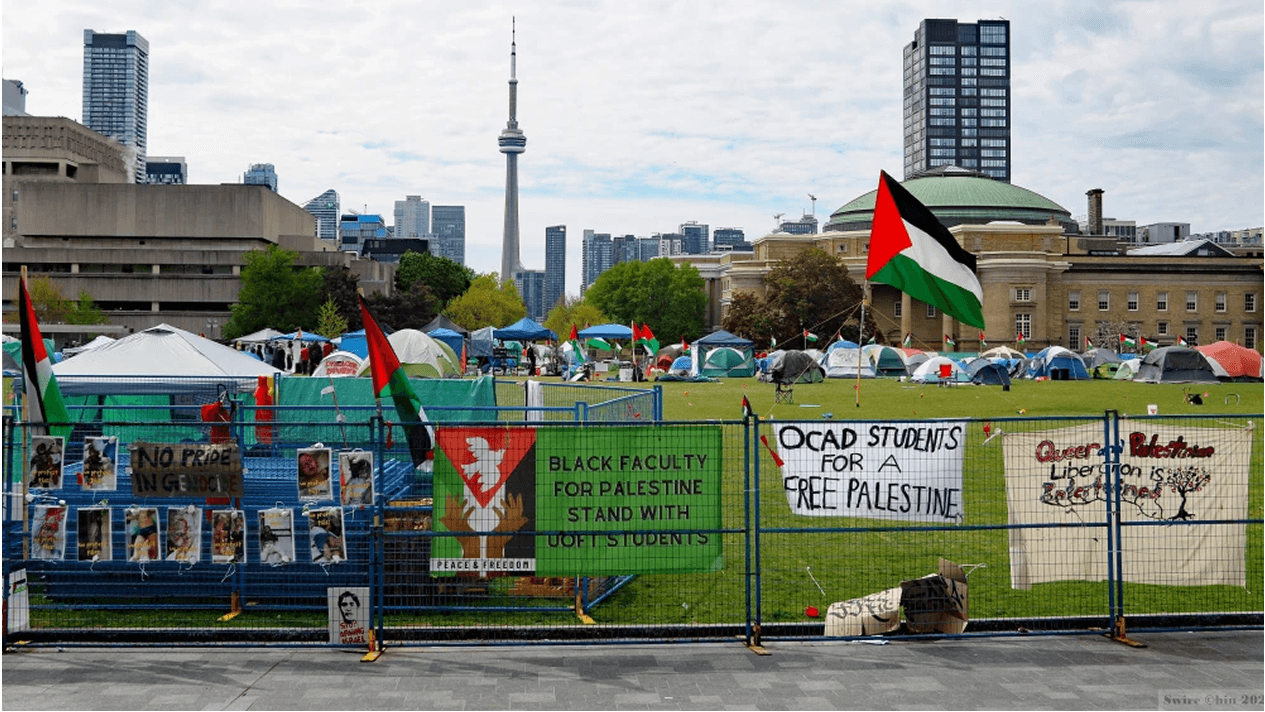
Pro-Palestinian demonstrators, students and faculty members have set up tents on the front lawn at King’s College Circle at the University of Toronto, May 10, 2024. Photo courtesy of Can Pac Swire/Flickr via Wikimedia Commons.
One of the most troubling—and intellectually dishonest—trends on North American campuses today is the insistence on equating anti-Semitism with Islamophobia.
Distortion
University administrators, fearful of backlash from other minority groups, have adopted a reflexive “both sides” approach. The result is reports, like those issued by Harvard and Brandeis universities, which treat the systematic targeting of Jewish students as morally and empirically equivalent to the subjective discomfort of Muslim students.
This is not nuance. It is distortion.
As I wrote in 2023, “There is no equivalence between Islamophobia and anti-Semitism. Muslims have not been persecuted around the world for thousands of years. No madman devised a ‘final solution’ for all believers of Islam. They have not been subjected to blood libels. They were not scientifically and systematically exterminated.”
To pretend otherwise is not only inaccurate but offensive.
Where?
If the two are equivalent, then the evidence on campus should be obvious. So where is it?
Where are the encampments protesting Muslim students or Hamas and Hezbollah terrorists?
Where are the Students and Faculty Against Muslims chapters?
Where are the faculty statements condemning Islam as inherently illegitimate?
Where are the departmental programs criticizing Muslims or Muslim states?
Where are the boycotts of Muslim-owned businesses and products?
Where are the calls for divesting from companies supplying weapons to Muslim countries?
Where are the mobs forcing Muslim students to run a gauntlet of hostility just to get to class, library or the dining hall?
Where are the students who were rewarded for assaulting Muslims?
Where are the student governments voting to isolate Muslim states?
Where are the eviction notices placed on the doors of Muslim students?
Where are the “apartheid walls” and “apartheid weeks” documenting the discrimination of non-Muslims by Muslims?
Where are the posters of kidnapped Muslims being torn down?
Where are the Muslim-sponsored activities disrupted by protesters?
Where are the Muslim students barred from student organizations because of their religion or support for terrorists?
Where are the departments dominated by faculty hostile to Islam and Muslim countries?
Where are the junior Muslim faculty who must hide their views on Islam or Muslim countries to be promoted?
Where are DEI programs discriminating against Muslim students?
Where are professors teaching a pseudo-intellectual paradigm comparable to intersectionality that singles out Muslims for opprobrium?
Where are students or faculty debating or dismissing the right of a Muslim state to exist?
ADVERTISEMENT
Where are the professional academic associations calling for boycotts of Muslims or Muslim countries?
Where are students’ grades impacted because they are Muslims or support Muslim causes?
Where are students denied study abroad in their choice of countries in the Middle East?
There is a campus movement targeting Jewish students. There is no comparable, organized movement on campus that seeks to marginalize Muslim students.
You would be hard-pressed to find examples of these patterns directed at Muslim students anywhere. Replace “Muslim” with “Jew,” however, and they appear across campuses nationwide. And the examples listed here are only a fraction of the evidence, illustrating just how deeply anti-Semitism has permeated campus culture.
Some Muslim students say they feel uncomfortable. That may be true. But discomfort is not the same as persecution. There is a difference between feeling targeted and being targeted.
Indeed, some Muslim spaces have been vandalized, and students have been harassed and physically assaulted. However, Jewish students are overwhelmingly the targets of these various forms of prejudice, just as FBI statistics show that outside the campus, Jews are far more likely (69% to 9%) to be victims of hate crimes than Muslims.
The truth is straightforward: There is a campus movement targeting Jewish students. There is no comparable, organized movement on campus that seeks to marginalize Muslim students.
Reality?
And yet, universities insist on treating “feelings” as equivalent to reality. University administrators are terrified of confronting anti-Semitism directly because doing so would put them at odds with powerful activist coalitions, many of which are deeply invested in anti-Israel ideology. They refuse to accept the widely adopted International Holocaust Remembrance Alliance working definition of anti-Semitism. They turn a specific problem into a generic one.
The Brandeis study argued that both groups share strikingly similar experiences of feeling excluded, harassed and unrecognized by peers outside their group. They suggest that building empathy around these shared experiences may be a more productive approach than treating the two communities as adversaries.
It is always the Jews who are asked to feel empathy. It reminds me of a study I did years ago of coexistence projects in Israel. It was always the Israeli Jews who initiated them, never Palestinians. Jews are always the first to speak out against the discrimination of others, but who speaks up for the Jews?
Where are the protests against anti-Semitism?
Where are the faculty statements defending Jewish students?
Where are the coalitions mobilizing when Jews are targeted?
By insisting on false equivalence, universities are doing three things:
• They are minimizing anti-Semitism, treating it as one issue among many instead of recognizing its scale.
• They are emboldening bad actors, signaling that harassment of Jewish students will be diluted and excused.
• They are isolating Jewish students, telling them—implicitly—that their experiences don’t count.
Then administrators wonder why the problem keeps getting worse.
Originally published at
JNS
ADVERTISEMENT
The false equivalence of campus hatred
Equating anti-Semitism with Islamophobia may sound even-handed on campus. The author argues it is neither honest nor harmless.
Mitchell Bard
4
mins read time
Originally published at
JNS
Pro-Palestinian demonstrators, students and faculty members have set up tents on the front lawn at King’s College Circle at the University of Toronto, May 10, 2024. Photo courtesy of Can Pac Swire/Flickr via Wikimedia Commons.
One of the most troubling—and intellectually dishonest—trends on North American campuses today is the insistence on equating anti-Semitism with Islamophobia.
Distortion
University administrators, fearful of backlash from other minority groups, have adopted a reflexive “both sides” approach. The result is reports, like those issued by Harvard and Brandeis universities, which treat the systematic targeting of Jewish students as morally and empirically equivalent to the subjective discomfort of Muslim students.
This is not nuance. It is distortion.
As I wrote in 2023, “There is no equivalence between Islamophobia and anti-Semitism. Muslims have not been persecuted around the world for thousands of years. No madman devised a ‘final solution’ for all believers of Islam. They have not been subjected to blood libels. They were not scientifically and systematically exterminated.”
To pretend otherwise is not only inaccurate but offensive.
Where?
If the two are equivalent, then the evidence on campus should be obvious. So where is it?
Where are the encampments protesting Muslim students or Hamas and Hezbollah terrorists?
Where are the Students and Faculty Against Muslims chapters?
Where are the faculty statements condemning Islam as inherently illegitimate?
Where are the departmental programs criticizing Muslims or Muslim states?
Where are the boycotts of Muslim-owned businesses and products?
Where are the calls for divesting from companies supplying weapons to Muslim countries?
Where are the mobs forcing Muslim students to run a gauntlet of hostility just to get to class, library or the dining hall?
Where are the students who were rewarded for assaulting Muslims?
Where are the student governments voting to isolate Muslim states?
Where are the eviction notices placed on the doors of Muslim students?
Where are the “apartheid walls” and “apartheid weeks” documenting the discrimination of non-Muslims by Muslims?
Where are the posters of kidnapped Muslims being torn down?
Where are the Muslim-sponsored activities disrupted by protesters?
Where are the Muslim students barred from student organizations because of their religion or support for terrorists?
Where are the departments dominated by faculty hostile to Islam and Muslim countries?
Where are the junior Muslim faculty who must hide their views on Islam or Muslim countries to be promoted?
Where are DEI programs discriminating against Muslim students?
Where are professors teaching a pseudo-intellectual paradigm comparable to intersectionality that singles out Muslims for opprobrium?
Where are students or faculty debating or dismissing the right of a Muslim state to exist?
ADVERTISEMENT
Where are the professional academic associations calling for boycotts of Muslims or Muslim countries?
Where are students’ grades impacted because they are Muslims or support Muslim causes?
Where are students denied study abroad in their choice of countries in the Middle East?
There is a campus movement targeting Jewish students. There is no comparable, organized movement on campus that seeks to marginalize Muslim students.
You would be hard-pressed to find examples of these patterns directed at Muslim students anywhere. Replace “Muslim” with “Jew,” however, and they appear across campuses nationwide. And the examples listed here are only a fraction of the evidence, illustrating just how deeply anti-Semitism has permeated campus culture.
Some Muslim students say they feel uncomfortable. That may be true. But discomfort is not the same as persecution. There is a difference between feeling targeted and being targeted.
Indeed, some Muslim spaces have been vandalized, and students have been harassed and physically assaulted. However, Jewish students are overwhelmingly the targets of these various forms of prejudice, just as FBI statistics show that outside the campus, Jews are far more likely (69% to 9%) to be victims of hate crimes than Muslims.
The truth is straightforward: There is a campus movement targeting Jewish students. There is no comparable, organized movement on campus that seeks to marginalize Muslim students.
Reality?
And yet, universities insist on treating “feelings” as equivalent to reality. University administrators are terrified of confronting anti-Semitism directly because doing so would put them at odds with powerful activist coalitions, many of which are deeply invested in anti-Israel ideology. They refuse to accept the widely adopted International Holocaust Remembrance Alliance working definition of anti-Semitism. They turn a specific problem into a generic one.
The Brandeis study argued that both groups share strikingly similar experiences of feeling excluded, harassed and unrecognized by peers outside their group. They suggest that building empathy around these shared experiences may be a more productive approach than treating the two communities as adversaries.
It is always the Jews who are asked to feel empathy. It reminds me of a study I did years ago of coexistence projects in Israel. It was always the Israeli Jews who initiated them, never Palestinians. Jews are always the first to speak out against the discrimination of others, but who speaks up for the Jews?
Where are the protests against anti-Semitism?
Where are the faculty statements defending Jewish students?
Where are the coalitions mobilizing when Jews are targeted?
By insisting on false equivalence, universities are doing three things:
• They are minimizing anti-Semitism, treating it as one issue among many instead of recognizing its scale.
• They are emboldening bad actors, signaling that harassment of Jewish students will be diluted and excused.
• They are isolating Jewish students, telling them—implicitly—that their experiences don’t count.
Then administrators wonder why the problem keeps getting worse.
Originally published at
JNS
ADVERTISEMENT
The false equivalence of campus hatred
Equating anti-Semitism with Islamophobia may sound even-handed on campus. The author argues it is neither honest nor harmless.
Mitchell Bard
4
mins read time
Originally published at
JNS
Pro-Palestinian demonstrators, students and faculty members have set up tents on the front lawn at King’s College Circle at the University of Toronto, May 10, 2024. Photo courtesy of Can Pac Swire/Flickr via Wikimedia Commons.
One of the most troubling—and intellectually dishonest—trends on North American campuses today is the insistence on equating anti-Semitism with Islamophobia.
Distortion
University administrators, fearful of backlash from other minority groups, have adopted a reflexive “both sides” approach. The result is reports, like those issued by Harvard and Brandeis universities, which treat the systematic targeting of Jewish students as morally and empirically equivalent to the subjective discomfort of Muslim students.
This is not nuance. It is distortion.
As I wrote in 2023, “There is no equivalence between Islamophobia and anti-Semitism. Muslims have not been persecuted around the world for thousands of years. No madman devised a ‘final solution’ for all believers of Islam. They have not been subjected to blood libels. They were not scientifically and systematically exterminated.”
To pretend otherwise is not only inaccurate but offensive.
Where?
If the two are equivalent, then the evidence on campus should be obvious. So where is it?
Where are the encampments protesting Muslim students or Hamas and Hezbollah terrorists?
Where are the Students and Faculty Against Muslims chapters?
Where are the faculty statements condemning Islam as inherently illegitimate?
Where are the departmental programs criticizing Muslims or Muslim states?
Where are the boycotts of Muslim-owned businesses and products?
Where are the calls for divesting from companies supplying weapons to Muslim countries?
Where are the mobs forcing Muslim students to run a gauntlet of hostility just to get to class, library or the dining hall?
Where are the students who were rewarded for assaulting Muslims?
Where are the student governments voting to isolate Muslim states?
Where are the eviction notices placed on the doors of Muslim students?
Where are the “apartheid walls” and “apartheid weeks” documenting the discrimination of non-Muslims by Muslims?
Where are the posters of kidnapped Muslims being torn down?
Where are the Muslim-sponsored activities disrupted by protesters?
Where are the Muslim students barred from student organizations because of their religion or support for terrorists?
Where are the departments dominated by faculty hostile to Islam and Muslim countries?
Where are the junior Muslim faculty who must hide their views on Islam or Muslim countries to be promoted?
Where are DEI programs discriminating against Muslim students?
Where are professors teaching a pseudo-intellectual paradigm comparable to intersectionality that singles out Muslims for opprobrium?
Where are students or faculty debating or dismissing the right of a Muslim state to exist?
ADVERTISEMENT
Where are the professional academic associations calling for boycotts of Muslims or Muslim countries?
Where are students’ grades impacted because they are Muslims or support Muslim causes?
Where are students denied study abroad in their choice of countries in the Middle East?
There is a campus movement targeting Jewish students. There is no comparable, organized movement on campus that seeks to marginalize Muslim students.
You would be hard-pressed to find examples of these patterns directed at Muslim students anywhere. Replace “Muslim” with “Jew,” however, and they appear across campuses nationwide. And the examples listed here are only a fraction of the evidence, illustrating just how deeply anti-Semitism has permeated campus culture.
Some Muslim students say they feel uncomfortable. That may be true. But discomfort is not the same as persecution. There is a difference between feeling targeted and being targeted.
Indeed, some Muslim spaces have been vandalized, and students have been harassed and physically assaulted. However, Jewish students are overwhelmingly the targets of these various forms of prejudice, just as FBI statistics show that outside the campus, Jews are far more likely (69% to 9%) to be victims of hate crimes than Muslims.
The truth is straightforward: There is a campus movement targeting Jewish students. There is no comparable, organized movement on campus that seeks to marginalize Muslim students.
Reality?
And yet, universities insist on treating “feelings” as equivalent to reality. University administrators are terrified of confronting anti-Semitism directly because doing so would put them at odds with powerful activist coalitions, many of which are deeply invested in anti-Israel ideology. They refuse to accept the widely adopted International Holocaust Remembrance Alliance working definition of anti-Semitism. They turn a specific problem into a generic one.
The Brandeis study argued that both groups share strikingly similar experiences of feeling excluded, harassed and unrecognized by peers outside their group. They suggest that building empathy around these shared experiences may be a more productive approach than treating the two communities as adversaries.
It is always the Jews who are asked to feel empathy. It reminds me of a study I did years ago of coexistence projects in Israel. It was always the Israeli Jews who initiated them, never Palestinians. Jews are always the first to speak out against the discrimination of others, but who speaks up for the Jews?
Where are the protests against anti-Semitism?
Where are the faculty statements defending Jewish students?
Where are the coalitions mobilizing when Jews are targeted?
By insisting on false equivalence, universities are doing three things:
• They are minimizing anti-Semitism, treating it as one issue among many instead of recognizing its scale.
• They are emboldening bad actors, signaling that harassment of Jewish students will be diluted and excused.
• They are isolating Jewish students, telling them—implicitly—that their experiences don’t count.
Then administrators wonder why the problem keeps getting worse.
Originally published at
JNS
ADVERTISEMENT
The false equivalence of campus hatred
Equating anti-Semitism with Islamophobia may sound even-handed on campus. The author argues it is neither honest nor harmless.
Mitchell Bard
4
mins read time
Originally published at
JNS
Pro-Palestinian demonstrators, students and faculty members have set up tents on the front lawn at King’s College Circle at the University of Toronto, May 10, 2024. Photo courtesy of Can Pac Swire/Flickr via Wikimedia Commons.
One of the most troubling—and intellectually dishonest—trends on North American campuses today is the insistence on equating anti-Semitism with Islamophobia.
Distortion
University administrators, fearful of backlash from other minority groups, have adopted a reflexive “both sides” approach. The result is reports, like those issued by Harvard and Brandeis universities, which treat the systematic targeting of Jewish students as morally and empirically equivalent to the subjective discomfort of Muslim students.
This is not nuance. It is distortion.
As I wrote in 2023, “There is no equivalence between Islamophobia and anti-Semitism. Muslims have not been persecuted around the world for thousands of years. No madman devised a ‘final solution’ for all believers of Islam. They have not been subjected to blood libels. They were not scientifically and systematically exterminated.”
To pretend otherwise is not only inaccurate but offensive.
Where?
If the two are equivalent, then the evidence on campus should be obvious. So where is it?
Where are the encampments protesting Muslim students or Hamas and Hezbollah terrorists?
Where are the Students and Faculty Against Muslims chapters?
Where are the faculty statements condemning Islam as inherently illegitimate?
Where are the departmental programs criticizing Muslims or Muslim states?
Where are the boycotts of Muslim-owned businesses and products?
Where are the calls for divesting from companies supplying weapons to Muslim countries?
Where are the mobs forcing Muslim students to run a gauntlet of hostility just to get to class, library or the dining hall?
Where are the students who were rewarded for assaulting Muslims?
Where are the student governments voting to isolate Muslim states?
Where are the eviction notices placed on the doors of Muslim students?
Where are the “apartheid walls” and “apartheid weeks” documenting the discrimination of non-Muslims by Muslims?
Where are the posters of kidnapped Muslims being torn down?
Where are the Muslim-sponsored activities disrupted by protesters?
Where are the Muslim students barred from student organizations because of their religion or support for terrorists?
Where are the departments dominated by faculty hostile to Islam and Muslim countries?
Where are the junior Muslim faculty who must hide their views on Islam or Muslim countries to be promoted?
Where are DEI programs discriminating against Muslim students?
Where are professors teaching a pseudo-intellectual paradigm comparable to intersectionality that singles out Muslims for opprobrium?
Where are students or faculty debating or dismissing the right of a Muslim state to exist?
ADVERTISEMENT
Where are the professional academic associations calling for boycotts of Muslims or Muslim countries?
Where are students’ grades impacted because they are Muslims or support Muslim causes?
Where are students denied study abroad in their choice of countries in the Middle East?
There is a campus movement targeting Jewish students. There is no comparable, organized movement on campus that seeks to marginalize Muslim students.
You would be hard-pressed to find examples of these patterns directed at Muslim students anywhere. Replace “Muslim” with “Jew,” however, and they appear across campuses nationwide. And the examples listed here are only a fraction of the evidence, illustrating just how deeply anti-Semitism has permeated campus culture.
Some Muslim students say they feel uncomfortable. That may be true. But discomfort is not the same as persecution. There is a difference between feeling targeted and being targeted.
Indeed, some Muslim spaces have been vandalized, and students have been harassed and physically assaulted. However, Jewish students are overwhelmingly the targets of these various forms of prejudice, just as FBI statistics show that outside the campus, Jews are far more likely (69% to 9%) to be victims of hate crimes than Muslims.
The truth is straightforward: There is a campus movement targeting Jewish students. There is no comparable, organized movement on campus that seeks to marginalize Muslim students.
Reality?
And yet, universities insist on treating “feelings” as equivalent to reality. University administrators are terrified of confronting anti-Semitism directly because doing so would put them at odds with powerful activist coalitions, many of which are deeply invested in anti-Israel ideology. They refuse to accept the widely adopted International Holocaust Remembrance Alliance working definition of anti-Semitism. They turn a specific problem into a generic one.
The Brandeis study argued that both groups share strikingly similar experiences of feeling excluded, harassed and unrecognized by peers outside their group. They suggest that building empathy around these shared experiences may be a more productive approach than treating the two communities as adversaries.
It is always the Jews who are asked to feel empathy. It reminds me of a study I did years ago of coexistence projects in Israel. It was always the Israeli Jews who initiated them, never Palestinians. Jews are always the first to speak out against the discrimination of others, but who speaks up for the Jews?
Where are the protests against anti-Semitism?
Where are the faculty statements defending Jewish students?
Where are the coalitions mobilizing when Jews are targeted?
By insisting on false equivalence, universities are doing three things:
• They are minimizing anti-Semitism, treating it as one issue among many instead of recognizing its scale.
• They are emboldening bad actors, signaling that harassment of Jewish students will be diluted and excused.
• They are isolating Jewish students, telling them—implicitly—that their experiences don’t count.
Then administrators wonder why the problem keeps getting worse.
ADVERTISEMENT
Originally published at
JNS
ADVERTISEMENT
Related News

World
Israel & Middle East
UN head opens G.A., accuses Israel of ‘bulldozing’ road to peace; others also blast Israel
UN chief Guterres accuses Israel of blocking Mideast peace at the General Assembly, as Jordan’s King Abdullah also criticizes Israel’s policies.
Mike Wagenheim
September 23, 2026

World
Israel & Middle East
Ukrainian President Zelenskyy honors Sharansky in Kyiv
Zelenskyy awarded Sharansky Ukraine’s Order of Merit for his Holocaust memory and outreach work.
Canaan Lidor
September 2, 2026

World
Israel & Middle East
Survivor pens open letter to students
A 98-year-old Holocaust survivor’s open letter urges Jewish students returning to campus to stand proudly and never let hatred define them.
JNS
September 1, 2026
World
Israel & Middle East
UN head opens G.A., accuses Israel of ‘bulldozing’ road to peace; others also blast Israel
UN chief Guterres accuses Israel of blocking Mideast peace at the General Assembly, as Jordan’s King Abdullah also criticizes Israel’s policies.
Mike Wagenheim
September 23, 2026
World
Israel & Middle East
Ukrainian President Zelenskyy honors Sharansky in Kyiv
Zelenskyy awarded Sharansky Ukraine’s Order of Merit for his Holocaust memory and outreach work.
Canaan Lidor
September 2, 2026
World
Israel & Middle East
Survivor pens open letter to students
A 98-year-old Holocaust survivor’s open letter urges Jewish students returning to campus to stand proudly and never let hatred define them.
JNS
September 1, 2026

World
U.S. / National
‘Felt like a lynch mob,’ a mom says of NYC-funded fest, in which performer accuses Israel of ‘war crimes’
A Brooklyn mom says a City-funded NYC puppet festival turned into anti-Israel protest theater mid-show, leaving her family shaken.
Debra Nussbaum Cohen
August 27, 2026

© 2026 The Jewish World · Since 1965 - The Capital Region's gateway to Jewish life
Designed and Developed by Ta-Da Studios
© 2026 The Jewish World · Since 1965 - The Capital Region's gateway to Jewish life
Designed and Developed by Ta-Da Studios
© 2026 The Jewish World · Since 1965 - The Capital Region's gateway to Jewish life
Designed and Developed by Ta-Da Studios
© 2026 The Jewish World · Since 1965 - The Capital Region's gateway to Jewish life
Designed and Developed by Ta-Da Studios