Ancient stone capital depicting a menorah on display
A 1,500-year-old limestone capital carved with an eight-branched menorah, found near Jerusalem, goes on display ahead of Israel’s Independence Day.
The Jewish World
2
mins read time
Originally published at
The Jewish World
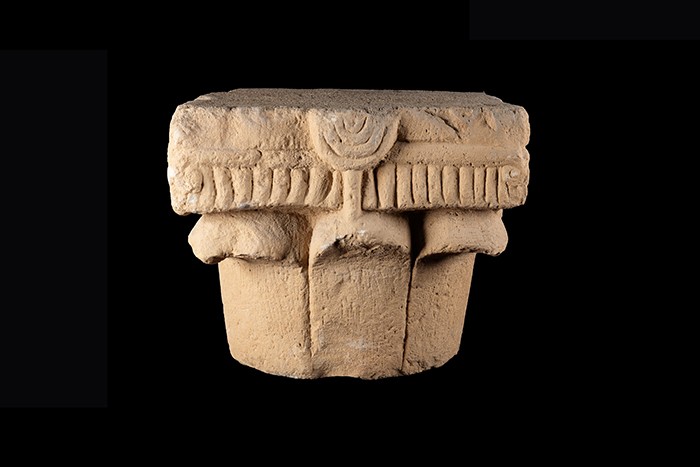
The stone capital. The only one of its kind in the world. Photo courtesy of Arkady Ostrovsky, Israel Antiquities Authority.
A 1,500 year-old stone capital decorated with a menorah, that was discovered just outside of Jerusalem, is on display ahead of Independence Day on the Jay and Jeanie Schottenstein National Campus for the Archaeology of Israel in Jerusalem, to note Independence Day, the Israel Antiquities Authority has announced.
The limestone capital, which is decorated with an eight-branched menorah, was unearthed five years ago during the construction of a new bridge at the entrance to Jerusalem in the bedroom community of Motza, the state-run archaeological body said. Israeli researchers believe the capital stood atop a pillar in a Roman-period building or street.
“The stone capital from the Jerusalem hills, decorated with the eight-branched menorah design, is unique, and a rare kind of discovery,” said Yuval Baruch, deputy director of archaeology at the IAA. He noted that a few decades after the Second Temple’s destruction, the menorah became the distinct symbol of the Jewish people, both in the diaspora and in the Land of Israel.
However, historical texts supported by archaeological research indicate that the Jewish settlement in Judea—and especially in the Jerusalem hills, suffered greatly as a result of the failed Bar Kokhba revolt in the 2nd century C.E., to the point of being considered eliminated.
“Based on this reality, it is reasonable to surmise that this capital [stone] was brought from a destroyed site elsewhere merely to serve as useful building material here,” said Baruch.

The capital as found in the field. Photo courtesy of Shai Halevi, Israel Antiquities Authority.
According to the Israeli Minister of Heritage, MK Rabbi Amichai Eliyahu:
“The discovery of the stone capital adorned with a menorah provides tangible evidence of the profound and undeniable connection between the Jewish people, Jerusalem, and the Land of Israel throughout thousands of years. This rare archaeological find, unparalleled anywhere in the world, serves as a bridge between our glorious past and the renewal of our independence in the State of Israel.”
“There is no more appropriate time to reveal this find to the public than in these very days of celebrating our identity as a nation,” said IAA Director Eli Escusido. “The connection to roots and to values is the source of our strength.”
ADVERTISEMENT
Originally published at
The Jewish World
ADVERTISEMENT
Ancient stone capital depicting a menorah on display
A 1,500-year-old limestone capital carved with an eight-branched menorah, found near Jerusalem, goes on display ahead of Israel’s Independence Day.
The Jewish World
2
mins read time
Originally published at
The Jewish World
The stone capital. The only one of its kind in the world. Photo courtesy of Arkady Ostrovsky, Israel Antiquities Authority.
A 1,500 year-old stone capital decorated with a menorah, that was discovered just outside of Jerusalem, is on display ahead of Independence Day on the Jay and Jeanie Schottenstein National Campus for the Archaeology of Israel in Jerusalem, to note Independence Day, the Israel Antiquities Authority has announced.
The limestone capital, which is decorated with an eight-branched menorah, was unearthed five years ago during the construction of a new bridge at the entrance to Jerusalem in the bedroom community of Motza, the state-run archaeological body said. Israeli researchers believe the capital stood atop a pillar in a Roman-period building or street.
“The stone capital from the Jerusalem hills, decorated with the eight-branched menorah design, is unique, and a rare kind of discovery,” said Yuval Baruch, deputy director of archaeology at the IAA. He noted that a few decades after the Second Temple’s destruction, the menorah became the distinct symbol of the Jewish people, both in the diaspora and in the Land of Israel.
However, historical texts supported by archaeological research indicate that the Jewish settlement in Judea—and especially in the Jerusalem hills, suffered greatly as a result of the failed Bar Kokhba revolt in the 2nd century C.E., to the point of being considered eliminated.
“Based on this reality, it is reasonable to surmise that this capital [stone] was brought from a destroyed site elsewhere merely to serve as useful building material here,” said Baruch.
The capital as found in the field. Photo courtesy of Shai Halevi, Israel Antiquities Authority.
According to the Israeli Minister of Heritage, MK Rabbi Amichai Eliyahu:
“The discovery of the stone capital adorned with a menorah provides tangible evidence of the profound and undeniable connection between the Jewish people, Jerusalem, and the Land of Israel throughout thousands of years. This rare archaeological find, unparalleled anywhere in the world, serves as a bridge between our glorious past and the renewal of our independence in the State of Israel.”
“There is no more appropriate time to reveal this find to the public than in these very days of celebrating our identity as a nation,” said IAA Director Eli Escusido. “The connection to roots and to values is the source of our strength.”
ADVERTISEMENT
Originally published at
The Jewish World
ADVERTISEMENT
Ancient stone capital depicting a menorah on display
A 1,500-year-old limestone capital carved with an eight-branched menorah, found near Jerusalem, goes on display ahead of Israel’s Independence Day.
The Jewish World
2
mins read time
Originally published at
The Jewish World
The stone capital. The only one of its kind in the world. Photo courtesy of Arkady Ostrovsky, Israel Antiquities Authority.
A 1,500 year-old stone capital decorated with a menorah, that was discovered just outside of Jerusalem, is on display ahead of Independence Day on the Jay and Jeanie Schottenstein National Campus for the Archaeology of Israel in Jerusalem, to note Independence Day, the Israel Antiquities Authority has announced.
The limestone capital, which is decorated with an eight-branched menorah, was unearthed five years ago during the construction of a new bridge at the entrance to Jerusalem in the bedroom community of Motza, the state-run archaeological body said. Israeli researchers believe the capital stood atop a pillar in a Roman-period building or street.
“The stone capital from the Jerusalem hills, decorated with the eight-branched menorah design, is unique, and a rare kind of discovery,” said Yuval Baruch, deputy director of archaeology at the IAA. He noted that a few decades after the Second Temple’s destruction, the menorah became the distinct symbol of the Jewish people, both in the diaspora and in the Land of Israel.
However, historical texts supported by archaeological research indicate that the Jewish settlement in Judea—and especially in the Jerusalem hills, suffered greatly as a result of the failed Bar Kokhba revolt in the 2nd century C.E., to the point of being considered eliminated.
“Based on this reality, it is reasonable to surmise that this capital [stone] was brought from a destroyed site elsewhere merely to serve as useful building material here,” said Baruch.
The capital as found in the field. Photo courtesy of Shai Halevi, Israel Antiquities Authority.
According to the Israeli Minister of Heritage, MK Rabbi Amichai Eliyahu:
“The discovery of the stone capital adorned with a menorah provides tangible evidence of the profound and undeniable connection between the Jewish people, Jerusalem, and the Land of Israel throughout thousands of years. This rare archaeological find, unparalleled anywhere in the world, serves as a bridge between our glorious past and the renewal of our independence in the State of Israel.”
“There is no more appropriate time to reveal this find to the public than in these very days of celebrating our identity as a nation,” said IAA Director Eli Escusido. “The connection to roots and to values is the source of our strength.”
ADVERTISEMENT
Originally published at
The Jewish World
ADVERTISEMENT
Ancient stone capital depicting a menorah on display
A 1,500-year-old limestone capital carved with an eight-branched menorah, found near Jerusalem, goes on display ahead of Israel’s Independence Day.
The Jewish World
2
mins read time
Originally published at
The Jewish World
The stone capital. The only one of its kind in the world. Photo courtesy of Arkady Ostrovsky, Israel Antiquities Authority.
A 1,500 year-old stone capital decorated with a menorah, that was discovered just outside of Jerusalem, is on display ahead of Independence Day on the Jay and Jeanie Schottenstein National Campus for the Archaeology of Israel in Jerusalem, to note Independence Day, the Israel Antiquities Authority has announced.
The limestone capital, which is decorated with an eight-branched menorah, was unearthed five years ago during the construction of a new bridge at the entrance to Jerusalem in the bedroom community of Motza, the state-run archaeological body said. Israeli researchers believe the capital stood atop a pillar in a Roman-period building or street.
“The stone capital from the Jerusalem hills, decorated with the eight-branched menorah design, is unique, and a rare kind of discovery,” said Yuval Baruch, deputy director of archaeology at the IAA. He noted that a few decades after the Second Temple’s destruction, the menorah became the distinct symbol of the Jewish people, both in the diaspora and in the Land of Israel.
However, historical texts supported by archaeological research indicate that the Jewish settlement in Judea—and especially in the Jerusalem hills, suffered greatly as a result of the failed Bar Kokhba revolt in the 2nd century C.E., to the point of being considered eliminated.
“Based on this reality, it is reasonable to surmise that this capital [stone] was brought from a destroyed site elsewhere merely to serve as useful building material here,” said Baruch.
The capital as found in the field. Photo courtesy of Shai Halevi, Israel Antiquities Authority.
According to the Israeli Minister of Heritage, MK Rabbi Amichai Eliyahu:
“The discovery of the stone capital adorned with a menorah provides tangible evidence of the profound and undeniable connection between the Jewish people, Jerusalem, and the Land of Israel throughout thousands of years. This rare archaeological find, unparalleled anywhere in the world, serves as a bridge between our glorious past and the renewal of our independence in the State of Israel.”
“There is no more appropriate time to reveal this find to the public than in these very days of celebrating our identity as a nation,” said IAA Director Eli Escusido. “The connection to roots and to values is the source of our strength.”
ADVERTISEMENT
ADVERTISEMENT
Originally published at
The Jewish World
ADVERTISEMENT
Related News

World
Israel & Middle East
Full text: Netanyahu’s address at the U.N. General Assembly 2026
Read Prime Minister Benjamin Netanyahu’s complete remarks to world leaders in New York, from Iran and Oct. 7 to the fight against antisemitism.
JNS
September 28, 2026

World
Israel & Middle East
Photos give glimpse of how Israelis celebrated Sukkot more than 60 years ago
Four rare KKL-JNF archive photos show how Israelis celebrated Sukkot decades ago, from a Jerusalem sukkah to a festive outdoor gathering.
The Jewish World
September 24, 2026

World
Religion & Philosophy
Walking into the new year: Who is with us?
Rabbi Yossy Goldman on the Chasidic parable of the King in the Field, and what should really drive us through the Days of Awe.
Rabbi Yossy Goldman
September 3, 2026
World
Israel & Middle East
Full text: Netanyahu’s address at the U.N. General Assembly 2026
Read Prime Minister Benjamin Netanyahu’s complete remarks to world leaders in New York, from Iran and Oct. 7 to the fight against antisemitism.
JNS
September 28, 2026
World
Israel & Middle East
Photos give glimpse of how Israelis celebrated Sukkot more than 60 years ago
Four rare KKL-JNF archive photos show how Israelis celebrated Sukkot decades ago, from a Jerusalem sukkah to a festive outdoor gathering.
The Jewish World
September 24, 2026
World
Religion & Philosophy
Walking into the new year: Who is with us?
Rabbi Yossy Goldman on the Chasidic parable of the King in the Field, and what should really drive us through the Days of Awe.
Rabbi Yossy Goldman
September 3, 2026

World
Israel & Middle East
Ukrainian President Zelenskyy honors Sharansky in Kyiv
Zelenskyy awarded Sharansky Ukraine’s Order of Merit for his Holocaust memory and outreach work.
Canaan Lidor
September 2, 2026

© 2026 The Jewish World · Since 1965 - The Capital Region's gateway to Jewish life
Designed and Developed by Ta-Da Studios
© 2026 The Jewish World · Since 1965 - The Capital Region's gateway to Jewish life
Designed and Developed by Ta-Da Studios
© 2026 The Jewish World · Since 1965 - The Capital Region's gateway to Jewish life
Designed and Developed by Ta-Da Studios
© 2026 The Jewish World · Since 1965 - The Capital Region's gateway to Jewish life
Designed and Developed by Ta-Da Studios