Christian-Jewish relations and the Catholic Church’s responses to major technological shifts
Pope Leo XIV warns about artificial intelligence threatening human dignity, continuing Church’s tradition of addressing transformative technologies.
The Jewish World
4
mins read time
Originally published at
The Jewish World
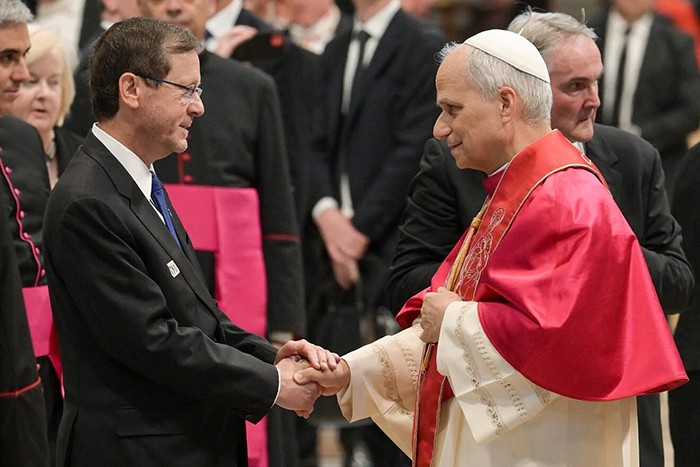
Israeli President Isaac Herzog shakes hands with Pope Leo XIV during the pope’s inauguration ceremony at the Vatican, May 18, 2025. Photo courtesy of Ma’ayan Toaf/GPO.
In his inaugural address, Pope Leo XIV expressed concerns about the rise of artificial intelligence, warning that it could undermine human dignity and replace human conscience with algorithms. The pope’s discomfort with AI resonates with a long history of the Catholic Church confronting transformative technologies that challenge its authority and influence.
While non-Catholics may have no place critiquing Vatican policy, Christian-Jewish relations have been impacted by its responses to major shifts. It thus behooves us to review those pivotal moments and apply their lessons today.
The printing press, invented by Johannes Gutenberg in the 15th century, marked a turning point in human history. It democratized knowledge, allowing the mass production of books and, for the first time, making texts like the Bible widely accessible. Yet, for the Catholic Church, the press was seen as a threat. The Church feared the loss of its monopoly on interpreting scripture, as individuals and groups began to interpret the Bible independently, leading to the Protestant Reformation.
The tremors of such reinterpretation extended far beyond the Christian community. For more than a millennium, the Catholic Church had promoted a theology that fueled anti-Semitism called “replacement theology” or “supersessionism.” According to this doctrine, God’s covenant with the Jews was superseded by the Christian covenant; biblical references to Jews, Israel, Hebrews and Zion were to be interpreted as symbolic of Christians. These teachings underpinned centuries of Christian hostility toward Jews.
While the Vatican struggled to control the flow of information, leaders of the Protestant Reformation utilized all the printing press had to offer to spread their ideas. Despite the continued commitment of Reformation leaders Martin Luther and John Calvin to their anti-Semitic proclivities, their newfound insistence on a literal reading of scripture laid the foundation for the modern Christian Zionist movement. Theodore Beza was the first Protestant leader to argue that God’s promises to the Jewish people, including their eventual return to their homeland, remained valid.
This new interpretation became a key driving force in supporting the Christian movement to restore the Jews to the Land of Israel. This revised doctrine culminated in the Balfour Declaration of 1917, and later, the U.N. Partition Plan of 1947, which led to the establishment of the modern-day State of Israel. Thus, the Catholic Church’s resistance to the information age ushered in by the printing press allowed others to fulfill God’s plan for the Jewish people.
ADVERTISEMENT
By contrast, when the next information revolution came in the 1990s with the advent of the Internet, the Vatican took a far more proactive stance. Pope John Paul II recognized the Internet’s potential for evangelization, calling it a tool for global dialogue and spiritual outreach. At the same time, the Internet made the promises of reconciliation between Catholics and Jews more accessible to a global audience. The Vatican’s commitment to interfaith dialogue, formalized in the “Nostra Aetate” declaration in 1965, was tested by the flood of information now available to Catholics and Jews alike.
With the rise of global accessibility via media, Catholic communities worldwide could access more information about Jewish history, the Holocaust and the ongoing Israeli-Palestinian conflict. This influx of information pressured the Vatican to reconsider its position on Israel. Pope John Paul II, recognizing the need for reconciliation, made a bold decision in 1993 to establish full diplomatic relations with Israel. This was a historic moment, signaling the Vatican’s acknowledgment of the Jewish people’s right to their homeland and the fulfillment of the promises made in “Nostra Aetate.”
Now, with the rise of artificial intelligence, Pope Leo XIV faces a new technological challenge. While AI promises to revolutionize industries, health care and daily life, the pope’s caution reflects a concern for how it could potentially dehumanize society, replacing the moral compass of individuals with cold, unfeeling algorithms. Yet history teaches that resisting the information age has led to missed opportunities. Just as the Catholic Church’s resistance to the printing press allowed Protestantism to take the lead in supporting the Jewish people’s return to Israel, a reluctance to engage with AI could undermine the Church’s moral authority in the modern world. Embracing new technology, however, could position the Vatican as a leader in guiding society through the moral implications of AI, just as it did when it embraced the Internet.
Pope Leo XIV has expressed his desire to end all wars, a noble and urgent mission. But achieving peace requires wisdom, foresight and the tools of the age. Rather than rejecting AI, he should lead the effort to ensure it is used responsibly to prevent atrocities, to monitor threats and to uphold the dignity of every person.
Originally published at
The Jewish World
ADVERTISEMENT
Christian-Jewish relations and the Catholic Church’s responses to major technological shifts
Pope Leo XIV warns about artificial intelligence threatening human dignity, continuing Church’s tradition of addressing transformative technologies.
The Jewish World
4
mins read time
Originally published at
The Jewish World
Israeli President Isaac Herzog shakes hands with Pope Leo XIV during the pope’s inauguration ceremony at the Vatican, May 18, 2025. Photo courtesy of Ma’ayan Toaf/GPO.
In his inaugural address, Pope Leo XIV expressed concerns about the rise of artificial intelligence, warning that it could undermine human dignity and replace human conscience with algorithms. The pope’s discomfort with AI resonates with a long history of the Catholic Church confronting transformative technologies that challenge its authority and influence.
While non-Catholics may have no place critiquing Vatican policy, Christian-Jewish relations have been impacted by its responses to major shifts. It thus behooves us to review those pivotal moments and apply their lessons today.
The printing press, invented by Johannes Gutenberg in the 15th century, marked a turning point in human history. It democratized knowledge, allowing the mass production of books and, for the first time, making texts like the Bible widely accessible. Yet, for the Catholic Church, the press was seen as a threat. The Church feared the loss of its monopoly on interpreting scripture, as individuals and groups began to interpret the Bible independently, leading to the Protestant Reformation.
The tremors of such reinterpretation extended far beyond the Christian community. For more than a millennium, the Catholic Church had promoted a theology that fueled anti-Semitism called “replacement theology” or “supersessionism.” According to this doctrine, God’s covenant with the Jews was superseded by the Christian covenant; biblical references to Jews, Israel, Hebrews and Zion were to be interpreted as symbolic of Christians. These teachings underpinned centuries of Christian hostility toward Jews.
While the Vatican struggled to control the flow of information, leaders of the Protestant Reformation utilized all the printing press had to offer to spread their ideas. Despite the continued commitment of Reformation leaders Martin Luther and John Calvin to their anti-Semitic proclivities, their newfound insistence on a literal reading of scripture laid the foundation for the modern Christian Zionist movement. Theodore Beza was the first Protestant leader to argue that God’s promises to the Jewish people, including their eventual return to their homeland, remained valid.
This new interpretation became a key driving force in supporting the Christian movement to restore the Jews to the Land of Israel. This revised doctrine culminated in the Balfour Declaration of 1917, and later, the U.N. Partition Plan of 1947, which led to the establishment of the modern-day State of Israel. Thus, the Catholic Church’s resistance to the information age ushered in by the printing press allowed others to fulfill God’s plan for the Jewish people.
ADVERTISEMENT
By contrast, when the next information revolution came in the 1990s with the advent of the Internet, the Vatican took a far more proactive stance. Pope John Paul II recognized the Internet’s potential for evangelization, calling it a tool for global dialogue and spiritual outreach. At the same time, the Internet made the promises of reconciliation between Catholics and Jews more accessible to a global audience. The Vatican’s commitment to interfaith dialogue, formalized in the “Nostra Aetate” declaration in 1965, was tested by the flood of information now available to Catholics and Jews alike.
With the rise of global accessibility via media, Catholic communities worldwide could access more information about Jewish history, the Holocaust and the ongoing Israeli-Palestinian conflict. This influx of information pressured the Vatican to reconsider its position on Israel. Pope John Paul II, recognizing the need for reconciliation, made a bold decision in 1993 to establish full diplomatic relations with Israel. This was a historic moment, signaling the Vatican’s acknowledgment of the Jewish people’s right to their homeland and the fulfillment of the promises made in “Nostra Aetate.”
Now, with the rise of artificial intelligence, Pope Leo XIV faces a new technological challenge. While AI promises to revolutionize industries, health care and daily life, the pope’s caution reflects a concern for how it could potentially dehumanize society, replacing the moral compass of individuals with cold, unfeeling algorithms. Yet history teaches that resisting the information age has led to missed opportunities. Just as the Catholic Church’s resistance to the printing press allowed Protestantism to take the lead in supporting the Jewish people’s return to Israel, a reluctance to engage with AI could undermine the Church’s moral authority in the modern world. Embracing new technology, however, could position the Vatican as a leader in guiding society through the moral implications of AI, just as it did when it embraced the Internet.
Pope Leo XIV has expressed his desire to end all wars, a noble and urgent mission. But achieving peace requires wisdom, foresight and the tools of the age. Rather than rejecting AI, he should lead the effort to ensure it is used responsibly to prevent atrocities, to monitor threats and to uphold the dignity of every person.
Originally published at
The Jewish World
ADVERTISEMENT
Christian-Jewish relations and the Catholic Church’s responses to major technological shifts
Pope Leo XIV warns about artificial intelligence threatening human dignity, continuing Church’s tradition of addressing transformative technologies.
The Jewish World
4
mins read time
Originally published at
The Jewish World
Israeli President Isaac Herzog shakes hands with Pope Leo XIV during the pope’s inauguration ceremony at the Vatican, May 18, 2025. Photo courtesy of Ma’ayan Toaf/GPO.
In his inaugural address, Pope Leo XIV expressed concerns about the rise of artificial intelligence, warning that it could undermine human dignity and replace human conscience with algorithms. The pope’s discomfort with AI resonates with a long history of the Catholic Church confronting transformative technologies that challenge its authority and influence.
While non-Catholics may have no place critiquing Vatican policy, Christian-Jewish relations have been impacted by its responses to major shifts. It thus behooves us to review those pivotal moments and apply their lessons today.
The printing press, invented by Johannes Gutenberg in the 15th century, marked a turning point in human history. It democratized knowledge, allowing the mass production of books and, for the first time, making texts like the Bible widely accessible. Yet, for the Catholic Church, the press was seen as a threat. The Church feared the loss of its monopoly on interpreting scripture, as individuals and groups began to interpret the Bible independently, leading to the Protestant Reformation.
The tremors of such reinterpretation extended far beyond the Christian community. For more than a millennium, the Catholic Church had promoted a theology that fueled anti-Semitism called “replacement theology” or “supersessionism.” According to this doctrine, God’s covenant with the Jews was superseded by the Christian covenant; biblical references to Jews, Israel, Hebrews and Zion were to be interpreted as symbolic of Christians. These teachings underpinned centuries of Christian hostility toward Jews.
While the Vatican struggled to control the flow of information, leaders of the Protestant Reformation utilized all the printing press had to offer to spread their ideas. Despite the continued commitment of Reformation leaders Martin Luther and John Calvin to their anti-Semitic proclivities, their newfound insistence on a literal reading of scripture laid the foundation for the modern Christian Zionist movement. Theodore Beza was the first Protestant leader to argue that God’s promises to the Jewish people, including their eventual return to their homeland, remained valid.
This new interpretation became a key driving force in supporting the Christian movement to restore the Jews to the Land of Israel. This revised doctrine culminated in the Balfour Declaration of 1917, and later, the U.N. Partition Plan of 1947, which led to the establishment of the modern-day State of Israel. Thus, the Catholic Church’s resistance to the information age ushered in by the printing press allowed others to fulfill God’s plan for the Jewish people.
ADVERTISEMENT
By contrast, when the next information revolution came in the 1990s with the advent of the Internet, the Vatican took a far more proactive stance. Pope John Paul II recognized the Internet’s potential for evangelization, calling it a tool for global dialogue and spiritual outreach. At the same time, the Internet made the promises of reconciliation between Catholics and Jews more accessible to a global audience. The Vatican’s commitment to interfaith dialogue, formalized in the “Nostra Aetate” declaration in 1965, was tested by the flood of information now available to Catholics and Jews alike.
With the rise of global accessibility via media, Catholic communities worldwide could access more information about Jewish history, the Holocaust and the ongoing Israeli-Palestinian conflict. This influx of information pressured the Vatican to reconsider its position on Israel. Pope John Paul II, recognizing the need for reconciliation, made a bold decision in 1993 to establish full diplomatic relations with Israel. This was a historic moment, signaling the Vatican’s acknowledgment of the Jewish people’s right to their homeland and the fulfillment of the promises made in “Nostra Aetate.”
Now, with the rise of artificial intelligence, Pope Leo XIV faces a new technological challenge. While AI promises to revolutionize industries, health care and daily life, the pope’s caution reflects a concern for how it could potentially dehumanize society, replacing the moral compass of individuals with cold, unfeeling algorithms. Yet history teaches that resisting the information age has led to missed opportunities. Just as the Catholic Church’s resistance to the printing press allowed Protestantism to take the lead in supporting the Jewish people’s return to Israel, a reluctance to engage with AI could undermine the Church’s moral authority in the modern world. Embracing new technology, however, could position the Vatican as a leader in guiding society through the moral implications of AI, just as it did when it embraced the Internet.
Pope Leo XIV has expressed his desire to end all wars, a noble and urgent mission. But achieving peace requires wisdom, foresight and the tools of the age. Rather than rejecting AI, he should lead the effort to ensure it is used responsibly to prevent atrocities, to monitor threats and to uphold the dignity of every person.
Originally published at
The Jewish World
ADVERTISEMENT
Christian-Jewish relations and the Catholic Church’s responses to major technological shifts
Pope Leo XIV warns about artificial intelligence threatening human dignity, continuing Church’s tradition of addressing transformative technologies.
The Jewish World
4
mins read time
Originally published at
The Jewish World
Israeli President Isaac Herzog shakes hands with Pope Leo XIV during the pope’s inauguration ceremony at the Vatican, May 18, 2025. Photo courtesy of Ma’ayan Toaf/GPO.
In his inaugural address, Pope Leo XIV expressed concerns about the rise of artificial intelligence, warning that it could undermine human dignity and replace human conscience with algorithms. The pope’s discomfort with AI resonates with a long history of the Catholic Church confronting transformative technologies that challenge its authority and influence.
While non-Catholics may have no place critiquing Vatican policy, Christian-Jewish relations have been impacted by its responses to major shifts. It thus behooves us to review those pivotal moments and apply their lessons today.
The printing press, invented by Johannes Gutenberg in the 15th century, marked a turning point in human history. It democratized knowledge, allowing the mass production of books and, for the first time, making texts like the Bible widely accessible. Yet, for the Catholic Church, the press was seen as a threat. The Church feared the loss of its monopoly on interpreting scripture, as individuals and groups began to interpret the Bible independently, leading to the Protestant Reformation.
The tremors of such reinterpretation extended far beyond the Christian community. For more than a millennium, the Catholic Church had promoted a theology that fueled anti-Semitism called “replacement theology” or “supersessionism.” According to this doctrine, God’s covenant with the Jews was superseded by the Christian covenant; biblical references to Jews, Israel, Hebrews and Zion were to be interpreted as symbolic of Christians. These teachings underpinned centuries of Christian hostility toward Jews.
While the Vatican struggled to control the flow of information, leaders of the Protestant Reformation utilized all the printing press had to offer to spread their ideas. Despite the continued commitment of Reformation leaders Martin Luther and John Calvin to their anti-Semitic proclivities, their newfound insistence on a literal reading of scripture laid the foundation for the modern Christian Zionist movement. Theodore Beza was the first Protestant leader to argue that God’s promises to the Jewish people, including their eventual return to their homeland, remained valid.
This new interpretation became a key driving force in supporting the Christian movement to restore the Jews to the Land of Israel. This revised doctrine culminated in the Balfour Declaration of 1917, and later, the U.N. Partition Plan of 1947, which led to the establishment of the modern-day State of Israel. Thus, the Catholic Church’s resistance to the information age ushered in by the printing press allowed others to fulfill God’s plan for the Jewish people.
ADVERTISEMENT
By contrast, when the next information revolution came in the 1990s with the advent of the Internet, the Vatican took a far more proactive stance. Pope John Paul II recognized the Internet’s potential for evangelization, calling it a tool for global dialogue and spiritual outreach. At the same time, the Internet made the promises of reconciliation between Catholics and Jews more accessible to a global audience. The Vatican’s commitment to interfaith dialogue, formalized in the “Nostra Aetate” declaration in 1965, was tested by the flood of information now available to Catholics and Jews alike.
With the rise of global accessibility via media, Catholic communities worldwide could access more information about Jewish history, the Holocaust and the ongoing Israeli-Palestinian conflict. This influx of information pressured the Vatican to reconsider its position on Israel. Pope John Paul II, recognizing the need for reconciliation, made a bold decision in 1993 to establish full diplomatic relations with Israel. This was a historic moment, signaling the Vatican’s acknowledgment of the Jewish people’s right to their homeland and the fulfillment of the promises made in “Nostra Aetate.”
Now, with the rise of artificial intelligence, Pope Leo XIV faces a new technological challenge. While AI promises to revolutionize industries, health care and daily life, the pope’s caution reflects a concern for how it could potentially dehumanize society, replacing the moral compass of individuals with cold, unfeeling algorithms. Yet history teaches that resisting the information age has led to missed opportunities. Just as the Catholic Church’s resistance to the printing press allowed Protestantism to take the lead in supporting the Jewish people’s return to Israel, a reluctance to engage with AI could undermine the Church’s moral authority in the modern world. Embracing new technology, however, could position the Vatican as a leader in guiding society through the moral implications of AI, just as it did when it embraced the Internet.
Pope Leo XIV has expressed his desire to end all wars, a noble and urgent mission. But achieving peace requires wisdom, foresight and the tools of the age. Rather than rejecting AI, he should lead the effort to ensure it is used responsibly to prevent atrocities, to monitor threats and to uphold the dignity of every person.
ADVERTISEMENT
Originally published at
The Jewish World
ADVERTISEMENT
Related News

Opinions
Columns
Heroic Israelis avert a tragedy in the sky
A columnist argues that ordinary Israelis and a relief crew foiled a suspected suicide hijacking, and that the skies remain dangerous.
Fiamma Nirenstein
October 1, 2026

Opinions
Columns
Let us bask in the glory of our accomplishments
Mitchell Bard argues it’s time to stop debating Zionism and treat its success as settled, not something to keep defending.
Mitchell Bard
September 17, 2026

Opinions
Columns
Get out your crystal ball! Take the 5787 Jewish pundit quiz
JNS columnist Jonathan S. Tobin reviews last year’s picks and previews the new Jewish year with his annual Rosh Hashanah pundit quiz.
Jonathan S. Tobin
September 17, 2026
Opinions
Columns
Heroic Israelis avert a tragedy in the sky
A columnist argues that ordinary Israelis and a relief crew foiled a suspected suicide hijacking, and that the skies remain dangerous.
Fiamma Nirenstein
October 1, 2026
Opinions
Columns
Let us bask in the glory of our accomplishments
Mitchell Bard argues it’s time to stop debating Zionism and treat its success as settled, not something to keep defending.
Mitchell Bard
September 17, 2026
Opinions
Columns
Get out your crystal ball! Take the 5787 Jewish pundit quiz
JNS columnist Jonathan S. Tobin reviews last year’s picks and previews the new Jewish year with his annual Rosh Hashanah pundit quiz.
Jonathan S. Tobin
September 17, 2026

Opinions
Personal Stories
Greeting the new year with memories of loved ones and past holidays
Marilyn Shapiro reflects on High Holy Day gatherings past and present, and on placing a stone at yizkor in memory of loved ones.
Marilyn Shapiro
September 10, 2026

© 2026 The Jewish World · Since 1965 - The Capital Region's gateway to Jewish life
Designed and Developed by Ta-Da Studios
© 2026 The Jewish World · Since 1965 - The Capital Region's gateway to Jewish life
Designed and Developed by Ta-Da Studios
© 2026 The Jewish World · Since 1965 - The Capital Region's gateway to Jewish life
Designed and Developed by Ta-Da Studios
© 2026 The Jewish World · Since 1965 - The Capital Region's gateway to Jewish life
Designed and Developed by Ta-Da Studios