‘Columbia didn’t do enough’ after protests, Senator Schumer tells ‘NYT’
Senator Schumer told the New York Times that Columbia University failed to adequately address antisemitism after protests but warned against cutting…
JNS
5 mins read
Published by
JNS
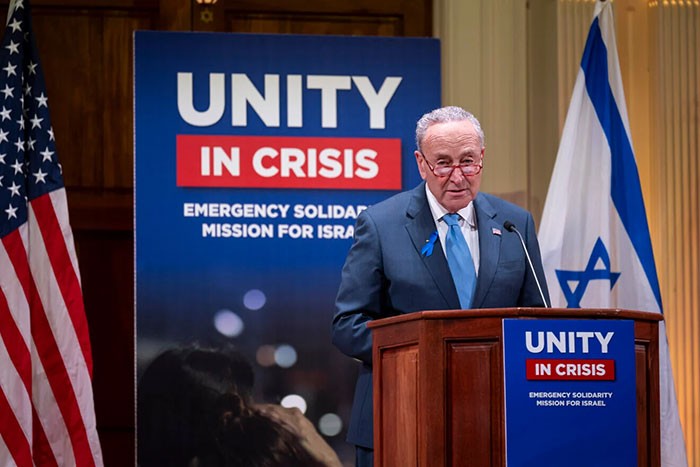
Senate Majority Leader Chuck Schumer (D-N.Y.) speaks at the Conference of Presidents of Major American Jewish Organizations gathering at Sixth & I synagogue, in Washington, D.C., on Oct. 17, 2023. Photo courtesy of Tia Dufour/U.S. Department of Homeland Security.
Columbia University failed to address Jew-hatred on campus adequately after last year’s anti-Israel protests, but withdrawing federal funding from the private school could have a lasting, negative impact, Senate Minority Leader Chuck Schumer (D-N.Y.) told the New York Times Magazine podcast “The Interview.”
The Jewish senator, who recently tabled a book tour citing “security concerns,” told Lulu Garcia-Navarro of the Times that he supports free speech but feels that Columbia let protests go too far, resulting in the Trump administration’s plan to withdraw $400 million in federal funding from the school.
“Didn’t Do Enough”
“I believe in the right to protest,” he said. “I started my career protesting the Vietnam War, and I say to some people, ‘If I were your age, I’d be protesting something or other.’”
“But when it shades over to violence and anti-Semitism, the colleges had to do something and a lot of them didn’t do enough,” he told the Times. “They shrugged their shoulders, looked the other way—Columbia among them.”
Schumer expressed concern that the Trump administration’s withdrawal of federal funding from Columbia could impact all students negatively, not just those involved in the protests. “They took away $400 million, and I’m trying to find out what they took away,” he said. “Are they taking away money from cancer research or Alzheimer’s? What is the $400 million? It could be hurting all students. Students who go there who have nothing to do with the protest, students who might have protested peacefully or Jewish students who were victims of some of those protests.”
Court Decision
Schumer told Garcia-Navarro it is up to the courts to determine if Mahmoud Khalil, a recent Columbia graduate who served as a spokesman for the anti-Semitic protests, will be deported. (U.S. Immigration and Customs Enforcement arrested Khalil earlier in March and authorities have said that he is guilty of supporting terror.)
“If he broke the law, he should be deported,” Schumer said. “If he didn’t break the law and just peacefully protested, he should not be deported. It’s plain and simple.”
“Look, I get protests in front of my house all the time, but they have to have a permit and they have to obey certain rules,” Schumer told the Times. “The bottom line is we have courts, and Khalil will go to court.”
“I have a lot of faith that the judge will give a fair ruling,” he said. “It’s not the Trump administration; it’s an independent federal judge.” (Prosecutors have sought to move jurisdiction from New York to New Jersey or Louisiana, where Khalil has been detained.)
Schumer also told the Times about his new book, Antisemitism in America: A Warning.
“As the highest-ranking Jewish, elected official, not only now but ever in America, I felt an obligation,” he said. “I had to write the book.” (Some critics have disputed Schumer’s oft-repeated statement about his rank.)
ADVERTISEMENT
Genocide Guilt?
Asked about the line between Jew-hatred and legitimate criticism of the Israeli government, Schumer said that criticism of Israel, particularly its military actions, is not inherently anti-Semitic, but “it begins to shade over, and it shades over in a bunch of different ways.”
“When you use the word ‘Zionist’ for Jew—‘you Zionist pig’—you mean ‘you Jewish pig,’” he told the Times. “There was an incident on the New York subway, and a bunch of people got on, protesters or whatever, and said, ‘all the Zionists, get off.’”
“When the head of the Brooklyn Museum, who was Jewish, but the Brooklyn Museum had nothing to do with Israel or taking positions on Israel—her house is smeared in red paint—that’s anti-Semitism,” he added.
Not What Happened!
Schumer noted that often, the slogans of pro-Palestinian protesters can “slide” into anti-Semitism as well.
“The one that bothers me the most is ‘genocide,’” he said. “Genocide is described as a country or some group that tries to wipe out a whole race of people, a whole nationality of people. So if Israel was not provoked and just invaded Gaza and shot at random Palestinians, Gazans, that would be genocide. That’s not what happened.”
“In fact, the opposite happened,” he said. “Hamas is much closer to genocidal than Israel.”
Schumer added that Hamas’s military strategy of using human shields makes it difficult to avoid civilian casualties, something he believes the media does not clearly convey to the public.“I mean, the news reports every day for a while showed Palestinians being hurt and killed, and I see the pictures of a little Palestinian boy without a leg,” he said. “One that sticks in my head—there’s a little girl, like 11, 12, crying because her parents were both killed, and I ache for that.”
“But on the news, they never mention that Hamas used the Palestinian people as human shields, and so when these protesters come and accuse Israel of genocide, I said, ‘what about Hamas?’” he said. “They don’t even want to talk about Hamas.”
The senator shared in the interview that he experienced little Jew-hatred growing up in 1950s Brooklyn, which he called a “golden age for Jewish people.” But the turn of the century saw anti-Semitism start to bubble up with a myriad of conspiracy theories, including Jewish/Israeli involvement in the terrorist attacks on the United States on Sept. 11, 2001, in addition to the financing of philanthropist George Soros, he said.
“But it was Oct. 7 that changed it all,” he said. “All of a sudden, anti-Semitism explodes in ways we’ve never seen and overt anti-Semitism.”
“For the first time, Jews I know started saying, ‘Oh, God, maybe it could happen here,’” he said. “No one thought it would happen here, but for the first time, the thought: Maybe it could happen here.”
ADVERTISEMENT
‘Columbia didn’t do enough’ after protests, Senator Schumer tells ‘NYT’
Senator Schumer told the New York Times that Columbia University failed to adequately address antisemitism after protests but warned against cutting…
JNS
5 mins read
Published by
JNS
Senate Majority Leader Chuck Schumer (D-N.Y.) speaks at the Conference of Presidents of Major American Jewish Organizations gathering at Sixth & I synagogue, in Washington, D.C., on Oct. 17, 2023. Photo courtesy of Tia Dufour/U.S. Department of Homeland Security.
Columbia University failed to address Jew-hatred on campus adequately after last year’s anti-Israel protests, but withdrawing federal funding from the private school could have a lasting, negative impact, Senate Minority Leader Chuck Schumer (D-N.Y.) told the New York Times Magazine podcast “The Interview.”
The Jewish senator, who recently tabled a book tour citing “security concerns,” told Lulu Garcia-Navarro of the Times that he supports free speech but feels that Columbia let protests go too far, resulting in the Trump administration’s plan to withdraw $400 million in federal funding from the school.
“Didn’t Do Enough”
“I believe in the right to protest,” he said. “I started my career protesting the Vietnam War, and I say to some people, ‘If I were your age, I’d be protesting something or other.’”
“But when it shades over to violence and anti-Semitism, the colleges had to do something and a lot of them didn’t do enough,” he told the Times. “They shrugged their shoulders, looked the other way—Columbia among them.”
Schumer expressed concern that the Trump administration’s withdrawal of federal funding from Columbia could impact all students negatively, not just those involved in the protests. “They took away $400 million, and I’m trying to find out what they took away,” he said. “Are they taking away money from cancer research or Alzheimer’s? What is the $400 million? It could be hurting all students. Students who go there who have nothing to do with the protest, students who might have protested peacefully or Jewish students who were victims of some of those protests.”
Court Decision
Schumer told Garcia-Navarro it is up to the courts to determine if Mahmoud Khalil, a recent Columbia graduate who served as a spokesman for the anti-Semitic protests, will be deported. (U.S. Immigration and Customs Enforcement arrested Khalil earlier in March and authorities have said that he is guilty of supporting terror.)
“If he broke the law, he should be deported,” Schumer said. “If he didn’t break the law and just peacefully protested, he should not be deported. It’s plain and simple.”
“Look, I get protests in front of my house all the time, but they have to have a permit and they have to obey certain rules,” Schumer told the Times. “The bottom line is we have courts, and Khalil will go to court.”
“I have a lot of faith that the judge will give a fair ruling,” he said. “It’s not the Trump administration; it’s an independent federal judge.” (Prosecutors have sought to move jurisdiction from New York to New Jersey or Louisiana, where Khalil has been detained.)
Schumer also told the Times about his new book, Antisemitism in America: A Warning.
“As the highest-ranking Jewish, elected official, not only now but ever in America, I felt an obligation,” he said. “I had to write the book.” (Some critics have disputed Schumer’s oft-repeated statement about his rank.)
ADVERTISEMENT
Genocide Guilt?
Asked about the line between Jew-hatred and legitimate criticism of the Israeli government, Schumer said that criticism of Israel, particularly its military actions, is not inherently anti-Semitic, but “it begins to shade over, and it shades over in a bunch of different ways.”
“When you use the word ‘Zionist’ for Jew—‘you Zionist pig’—you mean ‘you Jewish pig,’” he told the Times. “There was an incident on the New York subway, and a bunch of people got on, protesters or whatever, and said, ‘all the Zionists, get off.’”
“When the head of the Brooklyn Museum, who was Jewish, but the Brooklyn Museum had nothing to do with Israel or taking positions on Israel—her house is smeared in red paint—that’s anti-Semitism,” he added.
Not What Happened!
Schumer noted that often, the slogans of pro-Palestinian protesters can “slide” into anti-Semitism as well.
“The one that bothers me the most is ‘genocide,’” he said. “Genocide is described as a country or some group that tries to wipe out a whole race of people, a whole nationality of people. So if Israel was not provoked and just invaded Gaza and shot at random Palestinians, Gazans, that would be genocide. That’s not what happened.”
“In fact, the opposite happened,” he said. “Hamas is much closer to genocidal than Israel.”
Schumer added that Hamas’s military strategy of using human shields makes it difficult to avoid civilian casualties, something he believes the media does not clearly convey to the public.“I mean, the news reports every day for a while showed Palestinians being hurt and killed, and I see the pictures of a little Palestinian boy without a leg,” he said. “One that sticks in my head—there’s a little girl, like 11, 12, crying because her parents were both killed, and I ache for that.”
“But on the news, they never mention that Hamas used the Palestinian people as human shields, and so when these protesters come and accuse Israel of genocide, I said, ‘what about Hamas?’” he said. “They don’t even want to talk about Hamas.”
The senator shared in the interview that he experienced little Jew-hatred growing up in 1950s Brooklyn, which he called a “golden age for Jewish people.” But the turn of the century saw anti-Semitism start to bubble up with a myriad of conspiracy theories, including Jewish/Israeli involvement in the terrorist attacks on the United States on Sept. 11, 2001, in addition to the financing of philanthropist George Soros, he said.
“But it was Oct. 7 that changed it all,” he said. “All of a sudden, anti-Semitism explodes in ways we’ve never seen and overt anti-Semitism.”
“For the first time, Jews I know started saying, ‘Oh, God, maybe it could happen here,’” he said. “No one thought it would happen here, but for the first time, the thought: Maybe it could happen here.”
ADVERTISEMENT
‘Columbia didn’t do enough’ after protests, Senator Schumer tells ‘NYT’
Senator Schumer told the New York Times that Columbia University failed to adequately address antisemitism after protests but warned against cutting…
JNS
5 mins read
Published by
JNS
Senate Majority Leader Chuck Schumer (D-N.Y.) speaks at the Conference of Presidents of Major American Jewish Organizations gathering at Sixth & I synagogue, in Washington, D.C., on Oct. 17, 2023. Photo courtesy of Tia Dufour/U.S. Department of Homeland Security.
Columbia University failed to address Jew-hatred on campus adequately after last year’s anti-Israel protests, but withdrawing federal funding from the private school could have a lasting, negative impact, Senate Minority Leader Chuck Schumer (D-N.Y.) told the New York Times Magazine podcast “The Interview.”
The Jewish senator, who recently tabled a book tour citing “security concerns,” told Lulu Garcia-Navarro of the Times that he supports free speech but feels that Columbia let protests go too far, resulting in the Trump administration’s plan to withdraw $400 million in federal funding from the school.
“Didn’t Do Enough”
“I believe in the right to protest,” he said. “I started my career protesting the Vietnam War, and I say to some people, ‘If I were your age, I’d be protesting something or other.’”
“But when it shades over to violence and anti-Semitism, the colleges had to do something and a lot of them didn’t do enough,” he told the Times. “They shrugged their shoulders, looked the other way—Columbia among them.”
Schumer expressed concern that the Trump administration’s withdrawal of federal funding from Columbia could impact all students negatively, not just those involved in the protests. “They took away $400 million, and I’m trying to find out what they took away,” he said. “Are they taking away money from cancer research or Alzheimer’s? What is the $400 million? It could be hurting all students. Students who go there who have nothing to do with the protest, students who might have protested peacefully or Jewish students who were victims of some of those protests.”
Court Decision
Schumer told Garcia-Navarro it is up to the courts to determine if Mahmoud Khalil, a recent Columbia graduate who served as a spokesman for the anti-Semitic protests, will be deported. (U.S. Immigration and Customs Enforcement arrested Khalil earlier in March and authorities have said that he is guilty of supporting terror.)
“If he broke the law, he should be deported,” Schumer said. “If he didn’t break the law and just peacefully protested, he should not be deported. It’s plain and simple.”
“Look, I get protests in front of my house all the time, but they have to have a permit and they have to obey certain rules,” Schumer told the Times. “The bottom line is we have courts, and Khalil will go to court.”
“I have a lot of faith that the judge will give a fair ruling,” he said. “It’s not the Trump administration; it’s an independent federal judge.” (Prosecutors have sought to move jurisdiction from New York to New Jersey or Louisiana, where Khalil has been detained.)
Schumer also told the Times about his new book, Antisemitism in America: A Warning.
“As the highest-ranking Jewish, elected official, not only now but ever in America, I felt an obligation,” he said. “I had to write the book.” (Some critics have disputed Schumer’s oft-repeated statement about his rank.)
ADVERTISEMENT
Genocide Guilt?
Asked about the line between Jew-hatred and legitimate criticism of the Israeli government, Schumer said that criticism of Israel, particularly its military actions, is not inherently anti-Semitic, but “it begins to shade over, and it shades over in a bunch of different ways.”
“When you use the word ‘Zionist’ for Jew—‘you Zionist pig’—you mean ‘you Jewish pig,’” he told the Times. “There was an incident on the New York subway, and a bunch of people got on, protesters or whatever, and said, ‘all the Zionists, get off.’”
“When the head of the Brooklyn Museum, who was Jewish, but the Brooklyn Museum had nothing to do with Israel or taking positions on Israel—her house is smeared in red paint—that’s anti-Semitism,” he added.
Not What Happened!
Schumer noted that often, the slogans of pro-Palestinian protesters can “slide” into anti-Semitism as well.
“The one that bothers me the most is ‘genocide,’” he said. “Genocide is described as a country or some group that tries to wipe out a whole race of people, a whole nationality of people. So if Israel was not provoked and just invaded Gaza and shot at random Palestinians, Gazans, that would be genocide. That’s not what happened.”
“In fact, the opposite happened,” he said. “Hamas is much closer to genocidal than Israel.”
Schumer added that Hamas’s military strategy of using human shields makes it difficult to avoid civilian casualties, something he believes the media does not clearly convey to the public.“I mean, the news reports every day for a while showed Palestinians being hurt and killed, and I see the pictures of a little Palestinian boy without a leg,” he said. “One that sticks in my head—there’s a little girl, like 11, 12, crying because her parents were both killed, and I ache for that.”
“But on the news, they never mention that Hamas used the Palestinian people as human shields, and so when these protesters come and accuse Israel of genocide, I said, ‘what about Hamas?’” he said. “They don’t even want to talk about Hamas.”
The senator shared in the interview that he experienced little Jew-hatred growing up in 1950s Brooklyn, which he called a “golden age for Jewish people.” But the turn of the century saw anti-Semitism start to bubble up with a myriad of conspiracy theories, including Jewish/Israeli involvement in the terrorist attacks on the United States on Sept. 11, 2001, in addition to the financing of philanthropist George Soros, he said.
“But it was Oct. 7 that changed it all,” he said. “All of a sudden, anti-Semitism explodes in ways we’ve never seen and overt anti-Semitism.”
“For the first time, Jews I know started saying, ‘Oh, God, maybe it could happen here,’” he said. “No one thought it would happen here, but for the first time, the thought: Maybe it could happen here.”
ADVERTISEMENT
‘Columbia didn’t do enough’ after protests, Senator Schumer tells ‘NYT’
Senator Schumer told the New York Times that Columbia University failed to adequately address antisemitism after protests but warned against cutting…
JNS
5 mins read
Published by
JNS
Senate Majority Leader Chuck Schumer (D-N.Y.) speaks at the Conference of Presidents of Major American Jewish Organizations gathering at Sixth & I synagogue, in Washington, D.C., on Oct. 17, 2023. Photo courtesy of Tia Dufour/U.S. Department of Homeland Security.
Columbia University failed to address Jew-hatred on campus adequately after last year’s anti-Israel protests, but withdrawing federal funding from the private school could have a lasting, negative impact, Senate Minority Leader Chuck Schumer (D-N.Y.) told the New York Times Magazine podcast “The Interview.”
The Jewish senator, who recently tabled a book tour citing “security concerns,” told Lulu Garcia-Navarro of the Times that he supports free speech but feels that Columbia let protests go too far, resulting in the Trump administration’s plan to withdraw $400 million in federal funding from the school.
“Didn’t Do Enough”
“I believe in the right to protest,” he said. “I started my career protesting the Vietnam War, and I say to some people, ‘If I were your age, I’d be protesting something or other.’”
“But when it shades over to violence and anti-Semitism, the colleges had to do something and a lot of them didn’t do enough,” he told the Times. “They shrugged their shoulders, looked the other way—Columbia among them.”
Schumer expressed concern that the Trump administration’s withdrawal of federal funding from Columbia could impact all students negatively, not just those involved in the protests. “They took away $400 million, and I’m trying to find out what they took away,” he said. “Are they taking away money from cancer research or Alzheimer’s? What is the $400 million? It could be hurting all students. Students who go there who have nothing to do with the protest, students who might have protested peacefully or Jewish students who were victims of some of those protests.”
Court Decision
Schumer told Garcia-Navarro it is up to the courts to determine if Mahmoud Khalil, a recent Columbia graduate who served as a spokesman for the anti-Semitic protests, will be deported. (U.S. Immigration and Customs Enforcement arrested Khalil earlier in March and authorities have said that he is guilty of supporting terror.)
“If he broke the law, he should be deported,” Schumer said. “If he didn’t break the law and just peacefully protested, he should not be deported. It’s plain and simple.”
“Look, I get protests in front of my house all the time, but they have to have a permit and they have to obey certain rules,” Schumer told the Times. “The bottom line is we have courts, and Khalil will go to court.”
“I have a lot of faith that the judge will give a fair ruling,” he said. “It’s not the Trump administration; it’s an independent federal judge.” (Prosecutors have sought to move jurisdiction from New York to New Jersey or Louisiana, where Khalil has been detained.)
Schumer also told the Times about his new book, Antisemitism in America: A Warning.
“As the highest-ranking Jewish, elected official, not only now but ever in America, I felt an obligation,” he said. “I had to write the book.” (Some critics have disputed Schumer’s oft-repeated statement about his rank.)
ADVERTISEMENT
Genocide Guilt?
Asked about the line between Jew-hatred and legitimate criticism of the Israeli government, Schumer said that criticism of Israel, particularly its military actions, is not inherently anti-Semitic, but “it begins to shade over, and it shades over in a bunch of different ways.”
“When you use the word ‘Zionist’ for Jew—‘you Zionist pig’—you mean ‘you Jewish pig,’” he told the Times. “There was an incident on the New York subway, and a bunch of people got on, protesters or whatever, and said, ‘all the Zionists, get off.’”
“When the head of the Brooklyn Museum, who was Jewish, but the Brooklyn Museum had nothing to do with Israel or taking positions on Israel—her house is smeared in red paint—that’s anti-Semitism,” he added.
Not What Happened!
Schumer noted that often, the slogans of pro-Palestinian protesters can “slide” into anti-Semitism as well.
“The one that bothers me the most is ‘genocide,’” he said. “Genocide is described as a country or some group that tries to wipe out a whole race of people, a whole nationality of people. So if Israel was not provoked and just invaded Gaza and shot at random Palestinians, Gazans, that would be genocide. That’s not what happened.”
“In fact, the opposite happened,” he said. “Hamas is much closer to genocidal than Israel.”
Schumer added that Hamas’s military strategy of using human shields makes it difficult to avoid civilian casualties, something he believes the media does not clearly convey to the public.“I mean, the news reports every day for a while showed Palestinians being hurt and killed, and I see the pictures of a little Palestinian boy without a leg,” he said. “One that sticks in my head—there’s a little girl, like 11, 12, crying because her parents were both killed, and I ache for that.”
“But on the news, they never mention that Hamas used the Palestinian people as human shields, and so when these protesters come and accuse Israel of genocide, I said, ‘what about Hamas?’” he said. “They don’t even want to talk about Hamas.”
The senator shared in the interview that he experienced little Jew-hatred growing up in 1950s Brooklyn, which he called a “golden age for Jewish people.” But the turn of the century saw anti-Semitism start to bubble up with a myriad of conspiracy theories, including Jewish/Israeli involvement in the terrorist attacks on the United States on Sept. 11, 2001, in addition to the financing of philanthropist George Soros, he said.
“But it was Oct. 7 that changed it all,” he said. “All of a sudden, anti-Semitism explodes in ways we’ve never seen and overt anti-Semitism.”
“For the first time, Jews I know started saying, ‘Oh, God, maybe it could happen here,’” he said. “No one thought it would happen here, but for the first time, the thought: Maybe it could happen here.”
ADVERTISEMENT
Related News
World
Israel & Middle East
Hamas, Oct. 7 and the weaponization of rape
When, immediately after Oct. 7, 2023, several journalists and I entered the devastated kibbutzim in southern Israel, the first thing—the most…
Fiamma Nirenstein
May 14, 2026

World
Israel & Middle East
Sustained’ harassment of Jews at largest U.S. labor union, complaint alleges
Empty chairs in an academic lecture hall.Used here to represent the 3 million members of the National Education Association.
The Jewish World Team
May 14, 2026

World
Global
Hormuz blockade succeeds in choking off Iran’s oil lifeline
USS John Finn (DDG 113) sails behind USS Milius (DDG 69), USNS Carl Brashear (T-AKE-7), and USS George H.W.
David Isaac
May 14, 2026
World
Israel & Middle East
Hamas, Oct. 7 and the weaponization of rape
When, immediately after Oct. 7, 2023, several journalists and I entered the devastated kibbutzim in southern Israel, the first thing—the most…
Fiamma Nirenstein
May 14, 2026
World
Israel & Middle East
Sustained’ harassment of Jews at largest U.S. labor union, complaint alleges
Empty chairs in an academic lecture hall.Used here to represent the 3 million members of the National Education Association.
The Jewish World Team
May 14, 2026
World
Global
Hormuz blockade succeeds in choking off Iran’s oil lifeline
USS John Finn (DDG 113) sails behind USS Milius (DDG 69), USNS Carl Brashear (T-AKE-7), and USS George H.W.
David Isaac
May 14, 2026

World
U.S. / National
jscreen marks Jewish American Heritage Month
ATLANTA, Ga. – In recognition of Jewish American Heritage Month, the national public health initiative jscreen is celebrating the enduring legacy,…
The Jewish World Team
May 14, 2026

© 2026 The Jewish World · Since 1965 - The Capital Region's gateway to Jewish life
Designed and Developed by Ta-Da Studios
© 2026 The Jewish World · Since 1965 - The Capital Region's gateway to Jewish life
Designed and Developed by Ta-Da Studios
© 2026 The Jewish World · Since 1965 - The Capital Region's gateway to Jewish life
Designed and Developed by Ta-Da Studios
© 2026 The Jewish World · Since 1965 - The Capital Region's gateway to Jewish life
Designed and Developed by Ta-Da Studios