Inscription in Hippos may indicate oldest home for elderly
University of Haifa researchers discovered a mosaic inscription from 1600 years ago suggesting the world’s oldest known nursing home for elderly care.
The Jewish World
3
mins read time
Originally published at
The Jewish World
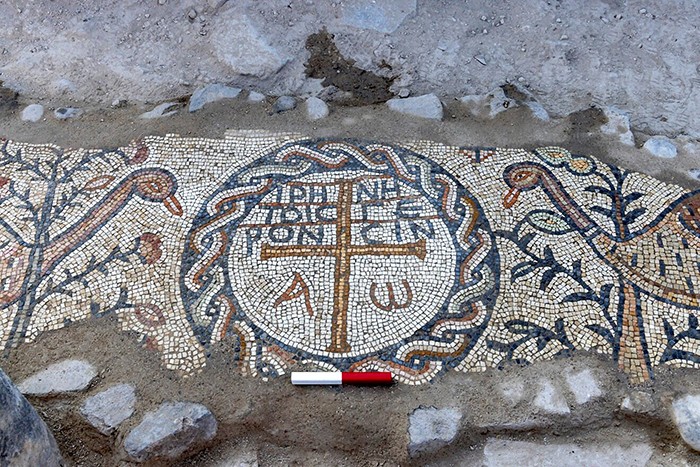
A close-up of the inscribed medallion flanked by Egyptian geese. Photo courtesy of Michael Eisenberg.
University of Haifa researchers have uncovered a Greek mosaic inscription bearing the unusual blessing, “Peace be with the elders,” during archaeological excavations in Hippos (Sussita National Park) near the Sea of Galilee. The inscription, dated to the late fourth or, at the latest, early fifth century C.E., likely points to the existence of the oldest known nursing home discovered in an archaeological excavation.
Not a modern idea
“This is living proof that care and concern for the elderly are not just a modern idea, but were part of social institutions and concepts as far back as about 1,600 years ago,” said Michael Eisenberg of the Zinman Institute of Archaeology and the Department of Archaeology at the University of Haifa, and co-director of the excavation project.

The ancient city remains on Mt. Sussita overlooking the Sea of Galilee. Photo courtesy of Michael Eisenberg.
The research team analyzed the Greek inscription linguistically, stylistically, and contextually, comparing it to historical sources from the Byzantine period that mention institutions for the elderly. They also examined iconographic depictions around the inscription, including Egyptian geese, cypress trees, fruits and vessels.
While such institutions are known from fifth- and sixth-century written sources, this is the first time physical evidence has been found directly linking to this type of activity.
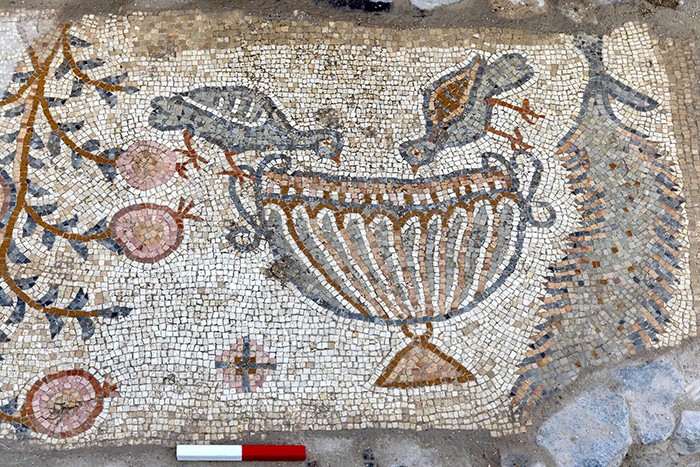
Birds drink from a chalice depicted on the mosaic. Photo courtesy of Michael Eisenberg.
ADVERTISEMENT
A Christian city
Hippos was the central Christian city in the Sea of Galilee region during the Byzantine period, serving as a bishop’s seat and hosting at least seven churches. Located on a hill overlooking the Sea of Galilee, the city has been the focus of systematic excavations, including extensive conservation efforts, since 2000. During the Byzantine period, Hippos functioned as a religious, social and economic hub, with its main streets—the decumanus maximus (east-west) and a network of cardines (north-south)—serving as primary thoroughfares.
“This was a communal and spiritual institution integrated into the fabric of city life and reflecting the social values of the period. The inscription addresses a specific public directly, which is a rare glimpse into the daily lives of older people in antiquity,” said the researchers.
“It may provide one of the earliest material testimonies in the Holy Land, showing how the Christian community began assuming responsibilities for care that had previously been handled by family networks alone. This development likely reflects new Christian ways of life outside traditional family structures,” researchers added.
Originally published at
The Jewish World
ADVERTISEMENT
Inscription in Hippos may indicate oldest home for elderly
University of Haifa researchers discovered a mosaic inscription from 1600 years ago suggesting the world’s oldest known nursing home for elderly care.
The Jewish World
3
mins read time
Originally published at
The Jewish World
A close-up of the inscribed medallion flanked by Egyptian geese. Photo courtesy of Michael Eisenberg.
University of Haifa researchers have uncovered a Greek mosaic inscription bearing the unusual blessing, “Peace be with the elders,” during archaeological excavations in Hippos (Sussita National Park) near the Sea of Galilee. The inscription, dated to the late fourth or, at the latest, early fifth century C.E., likely points to the existence of the oldest known nursing home discovered in an archaeological excavation.
Not a modern idea
“This is living proof that care and concern for the elderly are not just a modern idea, but were part of social institutions and concepts as far back as about 1,600 years ago,” said Michael Eisenberg of the Zinman Institute of Archaeology and the Department of Archaeology at the University of Haifa, and co-director of the excavation project.
The ancient city remains on Mt. Sussita overlooking the Sea of Galilee. Photo courtesy of Michael Eisenberg.
The research team analyzed the Greek inscription linguistically, stylistically, and contextually, comparing it to historical sources from the Byzantine period that mention institutions for the elderly. They also examined iconographic depictions around the inscription, including Egyptian geese, cypress trees, fruits and vessels.
While such institutions are known from fifth- and sixth-century written sources, this is the first time physical evidence has been found directly linking to this type of activity.
Birds drink from a chalice depicted on the mosaic. Photo courtesy of Michael Eisenberg.
ADVERTISEMENT
A Christian city
Hippos was the central Christian city in the Sea of Galilee region during the Byzantine period, serving as a bishop’s seat and hosting at least seven churches. Located on a hill overlooking the Sea of Galilee, the city has been the focus of systematic excavations, including extensive conservation efforts, since 2000. During the Byzantine period, Hippos functioned as a religious, social and economic hub, with its main streets—the decumanus maximus (east-west) and a network of cardines (north-south)—serving as primary thoroughfares.
“This was a communal and spiritual institution integrated into the fabric of city life and reflecting the social values of the period. The inscription addresses a specific public directly, which is a rare glimpse into the daily lives of older people in antiquity,” said the researchers.
“It may provide one of the earliest material testimonies in the Holy Land, showing how the Christian community began assuming responsibilities for care that had previously been handled by family networks alone. This development likely reflects new Christian ways of life outside traditional family structures,” researchers added.
Originally published at
The Jewish World
ADVERTISEMENT
Inscription in Hippos may indicate oldest home for elderly
University of Haifa researchers discovered a mosaic inscription from 1600 years ago suggesting the world’s oldest known nursing home for elderly care.
The Jewish World
3
mins read time
Originally published at
The Jewish World
A close-up of the inscribed medallion flanked by Egyptian geese. Photo courtesy of Michael Eisenberg.
University of Haifa researchers have uncovered a Greek mosaic inscription bearing the unusual blessing, “Peace be with the elders,” during archaeological excavations in Hippos (Sussita National Park) near the Sea of Galilee. The inscription, dated to the late fourth or, at the latest, early fifth century C.E., likely points to the existence of the oldest known nursing home discovered in an archaeological excavation.
Not a modern idea
“This is living proof that care and concern for the elderly are not just a modern idea, but were part of social institutions and concepts as far back as about 1,600 years ago,” said Michael Eisenberg of the Zinman Institute of Archaeology and the Department of Archaeology at the University of Haifa, and co-director of the excavation project.
The ancient city remains on Mt. Sussita overlooking the Sea of Galilee. Photo courtesy of Michael Eisenberg.
The research team analyzed the Greek inscription linguistically, stylistically, and contextually, comparing it to historical sources from the Byzantine period that mention institutions for the elderly. They also examined iconographic depictions around the inscription, including Egyptian geese, cypress trees, fruits and vessels.
While such institutions are known from fifth- and sixth-century written sources, this is the first time physical evidence has been found directly linking to this type of activity.
Birds drink from a chalice depicted on the mosaic. Photo courtesy of Michael Eisenberg.
ADVERTISEMENT
A Christian city
Hippos was the central Christian city in the Sea of Galilee region during the Byzantine period, serving as a bishop’s seat and hosting at least seven churches. Located on a hill overlooking the Sea of Galilee, the city has been the focus of systematic excavations, including extensive conservation efforts, since 2000. During the Byzantine period, Hippos functioned as a religious, social and economic hub, with its main streets—the decumanus maximus (east-west) and a network of cardines (north-south)—serving as primary thoroughfares.
“This was a communal and spiritual institution integrated into the fabric of city life and reflecting the social values of the period. The inscription addresses a specific public directly, which is a rare glimpse into the daily lives of older people in antiquity,” said the researchers.
“It may provide one of the earliest material testimonies in the Holy Land, showing how the Christian community began assuming responsibilities for care that had previously been handled by family networks alone. This development likely reflects new Christian ways of life outside traditional family structures,” researchers added.
Originally published at
The Jewish World
ADVERTISEMENT
Inscription in Hippos may indicate oldest home for elderly
University of Haifa researchers discovered a mosaic inscription from 1600 years ago suggesting the world’s oldest known nursing home for elderly care.
The Jewish World
3
mins read time
Originally published at
The Jewish World
A close-up of the inscribed medallion flanked by Egyptian geese. Photo courtesy of Michael Eisenberg.
University of Haifa researchers have uncovered a Greek mosaic inscription bearing the unusual blessing, “Peace be with the elders,” during archaeological excavations in Hippos (Sussita National Park) near the Sea of Galilee. The inscription, dated to the late fourth or, at the latest, early fifth century C.E., likely points to the existence of the oldest known nursing home discovered in an archaeological excavation.
Not a modern idea
“This is living proof that care and concern for the elderly are not just a modern idea, but were part of social institutions and concepts as far back as about 1,600 years ago,” said Michael Eisenberg of the Zinman Institute of Archaeology and the Department of Archaeology at the University of Haifa, and co-director of the excavation project.
The ancient city remains on Mt. Sussita overlooking the Sea of Galilee. Photo courtesy of Michael Eisenberg.
The research team analyzed the Greek inscription linguistically, stylistically, and contextually, comparing it to historical sources from the Byzantine period that mention institutions for the elderly. They also examined iconographic depictions around the inscription, including Egyptian geese, cypress trees, fruits and vessels.
While such institutions are known from fifth- and sixth-century written sources, this is the first time physical evidence has been found directly linking to this type of activity.
Birds drink from a chalice depicted on the mosaic. Photo courtesy of Michael Eisenberg.
ADVERTISEMENT
A Christian city
Hippos was the central Christian city in the Sea of Galilee region during the Byzantine period, serving as a bishop’s seat and hosting at least seven churches. Located on a hill overlooking the Sea of Galilee, the city has been the focus of systematic excavations, including extensive conservation efforts, since 2000. During the Byzantine period, Hippos functioned as a religious, social and economic hub, with its main streets—the decumanus maximus (east-west) and a network of cardines (north-south)—serving as primary thoroughfares.
“This was a communal and spiritual institution integrated into the fabric of city life and reflecting the social values of the period. The inscription addresses a specific public directly, which is a rare glimpse into the daily lives of older people in antiquity,” said the researchers.
“It may provide one of the earliest material testimonies in the Holy Land, showing how the Christian community began assuming responsibilities for care that had previously been handled by family networks alone. This development likely reflects new Christian ways of life outside traditional family structures,” researchers added.
ADVERTISEMENT
Originally published at
The Jewish World
ADVERTISEMENT
Related News

World
Israel & Middle East
Full text: Netanyahu’s address at the U.N. General Assembly 2026
Read Prime Minister Benjamin Netanyahu’s complete remarks to world leaders in New York, from Iran and Oct. 7 to the fight against antisemitism.
JNS
September 28, 2026

World
Israel & Middle East
U.S. denies Palestinian representatives again at UN as dispute over ICC, terror payments deepens
The U.S. again barred Palestinian Authority officials from the UN, citing ICC provocations against Israel and unended terror payments.
David Isaac
September 24, 2026

World
Israel & Middle East
Overcoming serious challenges, Israeli team conquers Kilimanjaro
Israelis facing disabilities, illness and loss joined dozens more to summit Mount Kilimanjaro in July, showing what resilience can accomplish.
Howard Blas
September 24, 2026
World
Israel & Middle East
Full text: Netanyahu’s address at the U.N. General Assembly 2026
Read Prime Minister Benjamin Netanyahu’s complete remarks to world leaders in New York, from Iran and Oct. 7 to the fight against antisemitism.
JNS
September 28, 2026
World
Israel & Middle East
U.S. denies Palestinian representatives again at UN as dispute over ICC, terror payments deepens
The U.S. again barred Palestinian Authority officials from the UN, citing ICC provocations against Israel and unended terror payments.
David Isaac
September 24, 2026
World
Israel & Middle East
Overcoming serious challenges, Israeli team conquers Kilimanjaro
Israelis facing disabilities, illness and loss joined dozens more to summit Mount Kilimanjaro in July, showing what resilience can accomplish.
Howard Blas
September 24, 2026

World
Israel & Middle East
Photos give glimpse of how Israelis celebrated Sukkot more than 60 years ago
Four rare KKL-JNF archive photos show how Israelis celebrated Sukkot decades ago, from a Jerusalem sukkah to a festive outdoor gathering.
The Jewish World
September 24, 2026

© 2026 The Jewish World · Since 1965 - The Capital Region's gateway to Jewish life
Designed and Developed by Ta-Da Studios
© 2026 The Jewish World · Since 1965 - The Capital Region's gateway to Jewish life
Designed and Developed by Ta-Da Studios
© 2026 The Jewish World · Since 1965 - The Capital Region's gateway to Jewish life
Designed and Developed by Ta-Da Studios
© 2026 The Jewish World · Since 1965 - The Capital Region's gateway to Jewish life
Designed and Developed by Ta-Da Studios