Photos give glimpse of how Israelis celebrated Sukkot more than 60 years ago
Four rare KKL-JNF archive photos show how Israelis celebrated Sukkot decades ago, from a Jerusalem sukkah to a festive outdoor gathering.
The Jewish World
3
mins read time
Originally published at
The Jewish World

A young boy is seen examining an etrog at Jerusalem’s Four Species Market in 1967. Photo courtesy of Avraham Malevsky, KKL-JNF.
Long before elaborately designed sukkahs, store-bought decorations and photos shared on social media, Sukkot in Israel was very much a communal celebration. The streets filled with lulavs and myrtle branches (chadassim), children marched in festive ceremonies, and families headed outdoors to celebrate the harvest festival. Four photographs from the Keren Kayemeth LeIsrael-Jewish National Fund (KKL-JNF) Photo Archive offer a glimpse of Israel more than six decades ago.
In a photograph from 1959, a Chasidic man is seen performing the mitzvah of the Four Species inside a sukkah in Jerusalem. Wrapped in a tallit, he holds a lulav and looks upward toward the s’chach, the natural covering of the sukkah. Around him are handmade decorations — paper chains, colorful ornaments and pictures hung on the sukkah’s walls. The intimate photograph captures a quiet moment of prayer and faith.
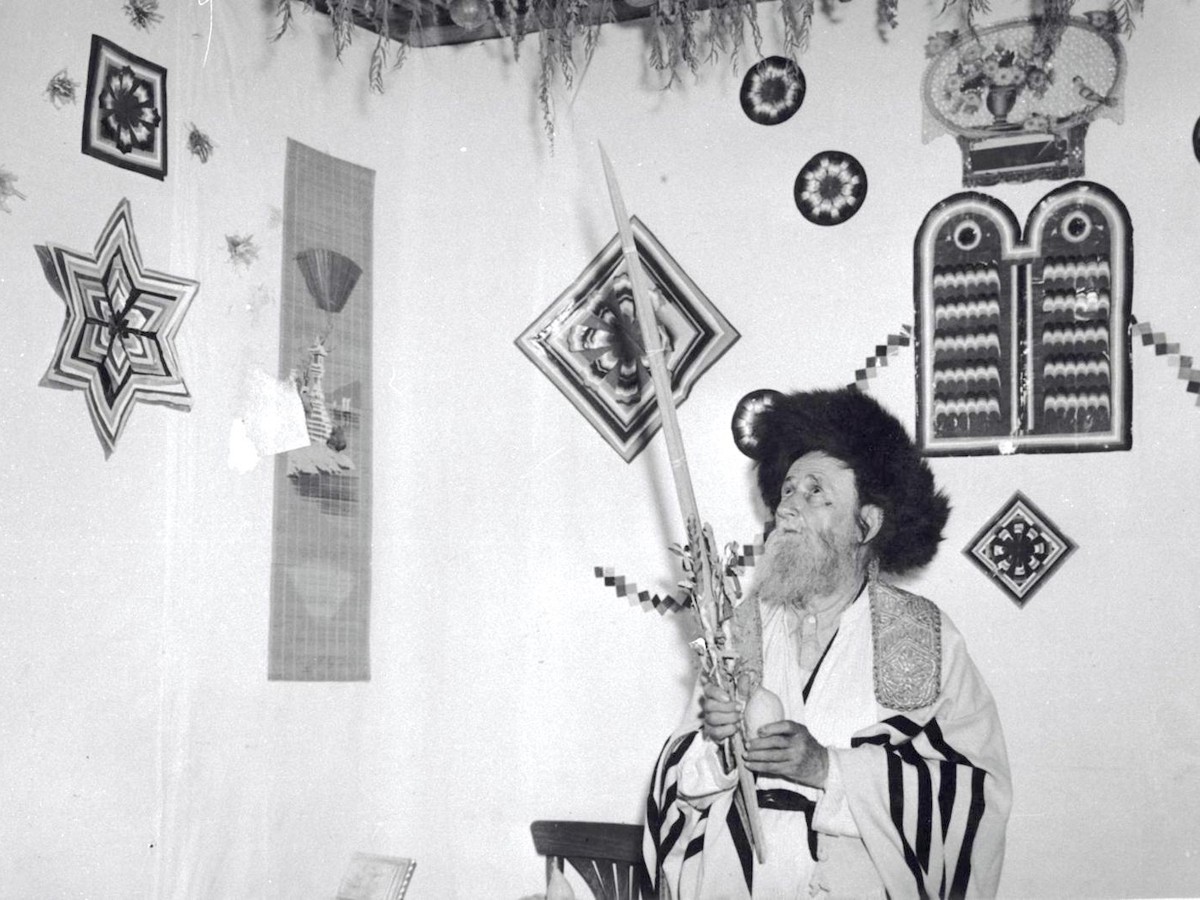
A man performs the mitzvah of the Four Species inside a sukkah in Jerusalem, 1959. Photo courtesy of Avraham Malevsky, KKL-JNF.
By contrast, a photograph taken at Horshat Tal in 1963 shows Sukkot as a large-scale Israeli celebration attended by crowds of people. Families and children gathered to celebrate the harvest festival, with dancers in matching attire standing at the center, holding sheaves of grain. Israeli flags fly above the participants, while the trees of the grove and the Galilee landscape can be seen in the background. The combination of an agricultural festival, folk dancing and time spent in nature tells the story of a young Israel seeking to connect ancient tradition with an emerging local culture.

Families and children celebrate Sukkot at Horshat Tal in 1963. Photo courtesy of Alex Strajmaister, KKL-JNF.
Another photograph, taken in 1964, documents children participating in the “Jerusalem Flag” ceremony during the intermediate days of Sukkot. Dressed in festive clothing, the children march in a procession carrying the Four Species, flowers, emblems and a large flag.
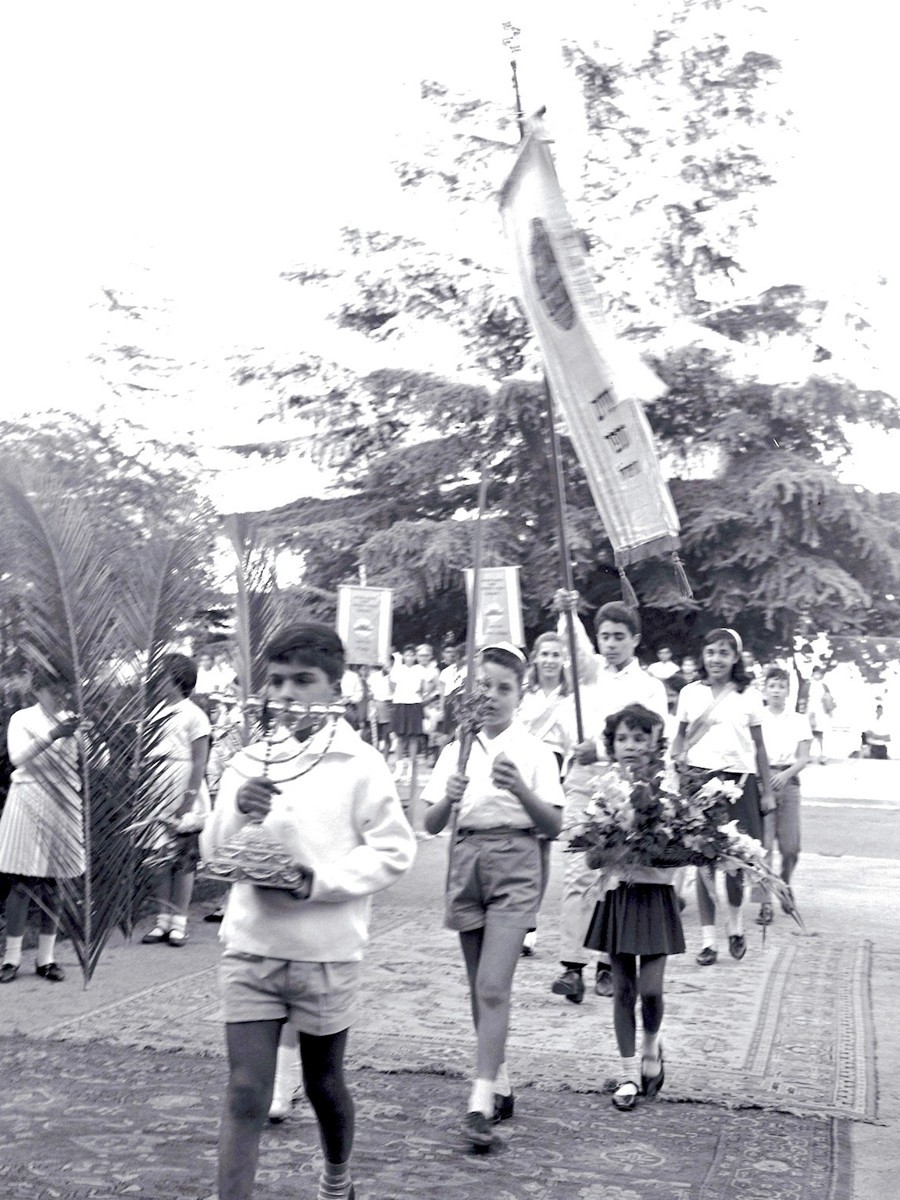
Children participating in the Jerusalem Flag Ceremony in Jerusalem in 1964. Photo courtesy of Martha Helwig, KKL-JNF.
The “Jerusalem Flag” was a nationwide educational initiative that began as early as 1934. Schools and kindergartens from across the country competed to carry out activities reflecting KKL-JNF’s values, including planting trees, activities on behalf of the land, and contributing to the iconic Blue Box. During Sukkot, the educational institution that won the competition received the flag in an impressive ceremony and kept it for one year, until it was passed on to the next winner. For the children who participated, it was much more than a ceremony: it was an experience that connected Sukkot, Jerusalem and the Zionist idea.
The fourth photograph was taken at Jerusalem’s Four Species market in 1967. At its center, a young boy is seen examining an etrog in one hand, surrounded by piles of lulavs, myrtle branches and fruit. Buyers and sellers crowd around him, inspecting the merchandise and preparing for the holiday. Even today, the boy’s concentrated expression and the packed market stall convey something of the excitement and bustle in the days leading up to the holiday.
Efrat Sinai, director of archives at KKL-JNF, said: “These photographs allow us to encounter Sukkot once again as it was celebrated in Israel decades ago, and as it is still celebrated today: in the family sukkah, at the Jerusalem market and at large outdoor gatherings. They show how tradition, Zionist education, agriculture and community came together to create the holiday’s unique Israeli character. Beyond their historical value, these are vibrant, deeply human moments that remind us how much we have changed, and how the customs of the holiday continue to connect generations.”
Sukkot begins the evening of Sept. 25 in 2026.
Originally published at
The Jewish World

Photos give glimpse of how Israelis celebrated Sukkot more than 60 years ago
Four rare KKL-JNF archive photos show how Israelis celebrated Sukkot decades ago, from a Jerusalem sukkah to a festive outdoor gathering.
The Jewish World
3
mins read time
Originally published at
The Jewish World
A young boy is seen examining an etrog at Jerusalem’s Four Species Market in 1967. Photo courtesy of Avraham Malevsky, KKL-JNF.
Long before elaborately designed sukkahs, store-bought decorations and photos shared on social media, Sukkot in Israel was very much a communal celebration. The streets filled with lulavs and myrtle branches (chadassim), children marched in festive ceremonies, and families headed outdoors to celebrate the harvest festival. Four photographs from the Keren Kayemeth LeIsrael-Jewish National Fund (KKL-JNF) Photo Archive offer a glimpse of Israel more than six decades ago.
In a photograph from 1959, a Chasidic man is seen performing the mitzvah of the Four Species inside a sukkah in Jerusalem. Wrapped in a tallit, he holds a lulav and looks upward toward the s’chach, the natural covering of the sukkah. Around him are handmade decorations — paper chains, colorful ornaments and pictures hung on the sukkah’s walls. The intimate photograph captures a quiet moment of prayer and faith.
A man performs the mitzvah of the Four Species inside a sukkah in Jerusalem, 1959. Photo courtesy of Avraham Malevsky, KKL-JNF.
By contrast, a photograph taken at Horshat Tal in 1963 shows Sukkot as a large-scale Israeli celebration attended by crowds of people. Families and children gathered to celebrate the harvest festival, with dancers in matching attire standing at the center, holding sheaves of grain. Israeli flags fly above the participants, while the trees of the grove and the Galilee landscape can be seen in the background. The combination of an agricultural festival, folk dancing and time spent in nature tells the story of a young Israel seeking to connect ancient tradition with an emerging local culture.
Families and children celebrate Sukkot at Horshat Tal in 1963. Photo courtesy of Alex Strajmaister, KKL-JNF.
Another photograph, taken in 1964, documents children participating in the “Jerusalem Flag” ceremony during the intermediate days of Sukkot. Dressed in festive clothing, the children march in a procession carrying the Four Species, flowers, emblems and a large flag.
Children participating in the Jerusalem Flag Ceremony in Jerusalem in 1964. Photo courtesy of Martha Helwig, KKL-JNF.
The “Jerusalem Flag” was a nationwide educational initiative that began as early as 1934. Schools and kindergartens from across the country competed to carry out activities reflecting KKL-JNF’s values, including planting trees, activities on behalf of the land, and contributing to the iconic Blue Box. During Sukkot, the educational institution that won the competition received the flag in an impressive ceremony and kept it for one year, until it was passed on to the next winner. For the children who participated, it was much more than a ceremony: it was an experience that connected Sukkot, Jerusalem and the Zionist idea.
The fourth photograph was taken at Jerusalem’s Four Species market in 1967. At its center, a young boy is seen examining an etrog in one hand, surrounded by piles of lulavs, myrtle branches and fruit. Buyers and sellers crowd around him, inspecting the merchandise and preparing for the holiday. Even today, the boy’s concentrated expression and the packed market stall convey something of the excitement and bustle in the days leading up to the holiday.
Efrat Sinai, director of archives at KKL-JNF, said: “These photographs allow us to encounter Sukkot once again as it was celebrated in Israel decades ago, and as it is still celebrated today: in the family sukkah, at the Jerusalem market and at large outdoor gatherings. They show how tradition, Zionist education, agriculture and community came together to create the holiday’s unique Israeli character. Beyond their historical value, these are vibrant, deeply human moments that remind us how much we have changed, and how the customs of the holiday continue to connect generations.”
Sukkot begins the evening of Sept. 25 in 2026.
Originally published at
The Jewish World
Photos give glimpse of how Israelis celebrated Sukkot more than 60 years ago
Four rare KKL-JNF archive photos show how Israelis celebrated Sukkot decades ago, from a Jerusalem sukkah to a festive outdoor gathering.
The Jewish World
3
mins read time
Originally published at
The Jewish World
A young boy is seen examining an etrog at Jerusalem’s Four Species Market in 1967. Photo courtesy of Avraham Malevsky, KKL-JNF.
Long before elaborately designed sukkahs, store-bought decorations and photos shared on social media, Sukkot in Israel was very much a communal celebration. The streets filled with lulavs and myrtle branches (chadassim), children marched in festive ceremonies, and families headed outdoors to celebrate the harvest festival. Four photographs from the Keren Kayemeth LeIsrael-Jewish National Fund (KKL-JNF) Photo Archive offer a glimpse of Israel more than six decades ago.
In a photograph from 1959, a Chasidic man is seen performing the mitzvah of the Four Species inside a sukkah in Jerusalem. Wrapped in a tallit, he holds a lulav and looks upward toward the s’chach, the natural covering of the sukkah. Around him are handmade decorations — paper chains, colorful ornaments and pictures hung on the sukkah’s walls. The intimate photograph captures a quiet moment of prayer and faith.
A man performs the mitzvah of the Four Species inside a sukkah in Jerusalem, 1959. Photo courtesy of Avraham Malevsky, KKL-JNF.
By contrast, a photograph taken at Horshat Tal in 1963 shows Sukkot as a large-scale Israeli celebration attended by crowds of people. Families and children gathered to celebrate the harvest festival, with dancers in matching attire standing at the center, holding sheaves of grain. Israeli flags fly above the participants, while the trees of the grove and the Galilee landscape can be seen in the background. The combination of an agricultural festival, folk dancing and time spent in nature tells the story of a young Israel seeking to connect ancient tradition with an emerging local culture.
Families and children celebrate Sukkot at Horshat Tal in 1963. Photo courtesy of Alex Strajmaister, KKL-JNF.
Another photograph, taken in 1964, documents children participating in the “Jerusalem Flag” ceremony during the intermediate days of Sukkot. Dressed in festive clothing, the children march in a procession carrying the Four Species, flowers, emblems and a large flag.
Children participating in the Jerusalem Flag Ceremony in Jerusalem in 1964. Photo courtesy of Martha Helwig, KKL-JNF.
The “Jerusalem Flag” was a nationwide educational initiative that began as early as 1934. Schools and kindergartens from across the country competed to carry out activities reflecting KKL-JNF’s values, including planting trees, activities on behalf of the land, and contributing to the iconic Blue Box. During Sukkot, the educational institution that won the competition received the flag in an impressive ceremony and kept it for one year, until it was passed on to the next winner. For the children who participated, it was much more than a ceremony: it was an experience that connected Sukkot, Jerusalem and the Zionist idea.
The fourth photograph was taken at Jerusalem’s Four Species market in 1967. At its center, a young boy is seen examining an etrog in one hand, surrounded by piles of lulavs, myrtle branches and fruit. Buyers and sellers crowd around him, inspecting the merchandise and preparing for the holiday. Even today, the boy’s concentrated expression and the packed market stall convey something of the excitement and bustle in the days leading up to the holiday.
Efrat Sinai, director of archives at KKL-JNF, said: “These photographs allow us to encounter Sukkot once again as it was celebrated in Israel decades ago, and as it is still celebrated today: in the family sukkah, at the Jerusalem market and at large outdoor gatherings. They show how tradition, Zionist education, agriculture and community came together to create the holiday’s unique Israeli character. Beyond their historical value, these are vibrant, deeply human moments that remind us how much we have changed, and how the customs of the holiday continue to connect generations.”
Sukkot begins the evening of Sept. 25 in 2026.
Originally published at
The Jewish World
Photos give glimpse of how Israelis celebrated Sukkot more than 60 years ago
Four rare KKL-JNF archive photos show how Israelis celebrated Sukkot decades ago, from a Jerusalem sukkah to a festive outdoor gathering.
The Jewish World
3
mins read time
Originally published at
The Jewish World
A young boy is seen examining an etrog at Jerusalem’s Four Species Market in 1967. Photo courtesy of Avraham Malevsky, KKL-JNF.
Long before elaborately designed sukkahs, store-bought decorations and photos shared on social media, Sukkot in Israel was very much a communal celebration. The streets filled with lulavs and myrtle branches (chadassim), children marched in festive ceremonies, and families headed outdoors to celebrate the harvest festival. Four photographs from the Keren Kayemeth LeIsrael-Jewish National Fund (KKL-JNF) Photo Archive offer a glimpse of Israel more than six decades ago.
In a photograph from 1959, a Chasidic man is seen performing the mitzvah of the Four Species inside a sukkah in Jerusalem. Wrapped in a tallit, he holds a lulav and looks upward toward the s’chach, the natural covering of the sukkah. Around him are handmade decorations — paper chains, colorful ornaments and pictures hung on the sukkah’s walls. The intimate photograph captures a quiet moment of prayer and faith.
A man performs the mitzvah of the Four Species inside a sukkah in Jerusalem, 1959. Photo courtesy of Avraham Malevsky, KKL-JNF.
By contrast, a photograph taken at Horshat Tal in 1963 shows Sukkot as a large-scale Israeli celebration attended by crowds of people. Families and children gathered to celebrate the harvest festival, with dancers in matching attire standing at the center, holding sheaves of grain. Israeli flags fly above the participants, while the trees of the grove and the Galilee landscape can be seen in the background. The combination of an agricultural festival, folk dancing and time spent in nature tells the story of a young Israel seeking to connect ancient tradition with an emerging local culture.
Families and children celebrate Sukkot at Horshat Tal in 1963. Photo courtesy of Alex Strajmaister, KKL-JNF.
Another photograph, taken in 1964, documents children participating in the “Jerusalem Flag” ceremony during the intermediate days of Sukkot. Dressed in festive clothing, the children march in a procession carrying the Four Species, flowers, emblems and a large flag.
Children participating in the Jerusalem Flag Ceremony in Jerusalem in 1964. Photo courtesy of Martha Helwig, KKL-JNF.
The “Jerusalem Flag” was a nationwide educational initiative that began as early as 1934. Schools and kindergartens from across the country competed to carry out activities reflecting KKL-JNF’s values, including planting trees, activities on behalf of the land, and contributing to the iconic Blue Box. During Sukkot, the educational institution that won the competition received the flag in an impressive ceremony and kept it for one year, until it was passed on to the next winner. For the children who participated, it was much more than a ceremony: it was an experience that connected Sukkot, Jerusalem and the Zionist idea.
The fourth photograph was taken at Jerusalem’s Four Species market in 1967. At its center, a young boy is seen examining an etrog in one hand, surrounded by piles of lulavs, myrtle branches and fruit. Buyers and sellers crowd around him, inspecting the merchandise and preparing for the holiday. Even today, the boy’s concentrated expression and the packed market stall convey something of the excitement and bustle in the days leading up to the holiday.
Efrat Sinai, director of archives at KKL-JNF, said: “These photographs allow us to encounter Sukkot once again as it was celebrated in Israel decades ago, and as it is still celebrated today: in the family sukkah, at the Jerusalem market and at large outdoor gatherings. They show how tradition, Zionist education, agriculture and community came together to create the holiday’s unique Israeli character. Beyond their historical value, these are vibrant, deeply human moments that remind us how much we have changed, and how the customs of the holiday continue to connect generations.”
Sukkot begins the evening of Sept. 25 in 2026.
Originally published at
The Jewish World
Related News

World
Israel & Middle East
Who gets the shekels this new year? Israel’s changing charity map
Jgive and the Central Fund for Israel say holiday giving is shifting toward PTSD care and homegrown Israeli donors since Oct. 7, not drying up.
Judith Segaloff
September 24, 2026
World
Religion & Philosophy
Walking into the new year: Who is with us?
Rabbi Yossy Goldman on the Chasidic parable of the King in the Field, and what should really drive us through the Days of Awe.
Rabbi Yossy Goldman
September 3, 2026

World
Israel & Middle East
Ukrainian President Zelenskyy honors Sharansky in Kyiv
Zelenskyy awarded Sharansky Ukraine’s Order of Merit for his Holocaust memory and outreach work.
Canaan Lidor
September 2, 2026
World
Israel & Middle East
Who gets the shekels this new year? Israel’s changing charity map
Jgive and the Central Fund for Israel say holiday giving is shifting toward PTSD care and homegrown Israeli donors since Oct. 7, not drying up.
Judith Segaloff
September 24, 2026
World
Religion & Philosophy
Walking into the new year: Who is with us?
Rabbi Yossy Goldman on the Chasidic parable of the King in the Field, and what should really drive us through the Days of Awe.
Rabbi Yossy Goldman
September 3, 2026
World
Israel & Middle East
Ukrainian President Zelenskyy honors Sharansky in Kyiv
Zelenskyy awarded Sharansky Ukraine’s Order of Merit for his Holocaust memory and outreach work.
Canaan Lidor
September 2, 2026

World
Personal Stories
Jacqueline Meents-Lenstra hid Efraim Kochba as her own son in Nazi-occupied Holland
Jacqueline Meents-Lenstra hid a Jewish baby as her own during the Holocaust. Decades later, Yad Vashem honored her heroism.
Etgar Lefkovits
August 26, 2026

© 2026 The Jewish World · Since 1965 - The Capital Region's gateway to Jewish life
Designed and Developed by Ta-Da Studios
© 2026 The Jewish World · Since 1965 - The Capital Region's gateway to Jewish life
Designed and Developed by Ta-Da Studios
© 2026 The Jewish World · Since 1965 - The Capital Region's gateway to Jewish life
Designed and Developed by Ta-Da Studios
© 2026 The Jewish World · Since 1965 - The Capital Region's gateway to Jewish life
Designed and Developed by Ta-Da Studios