
Shalom,
!
Saturday, November 28, 2026
Saturday, November 28, 2026
Shalom,
!
Saturday, November 28, 2026
Saturday, November 28, 2026
Shalom,
!
Saturday, November 28, 2026
Saturday, November 28, 2026
Shalom,
!
Saturday, November 28, 2026
Saturday, November 28, 2026
Only let congregants on security teams bring guns to synagogue, security group advises
Security experts advise synagogues to restrict armed individuals to trained, organized security teams rather than allowing congregants to carry…
Aaron Bandler
3
mins read time
Originally published at
JNS
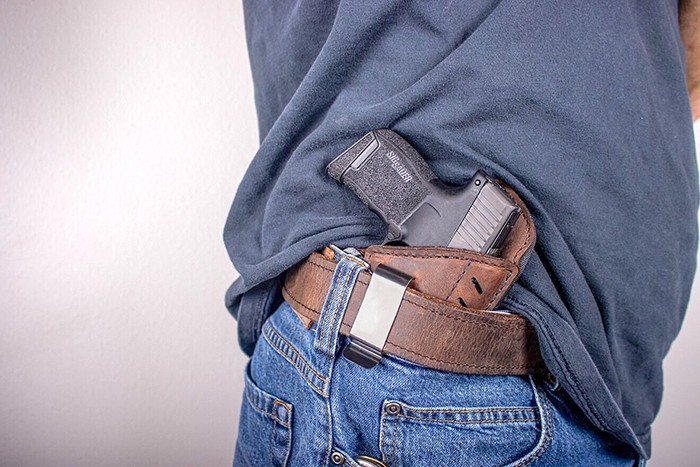
A gun holstered on a person’s belt. Photo courtesy of gmsjs90/Pixabay.
American congregations shouldn’t allow individuals to carry weapons to synagogue unless they are part of the synagogue’s volunteer security team, according to Michael Masters, national director and CEO of the Secure Community Network. “Allowing individuals in an unstructured, unplanned way to carry guns in a house of worship is simply not a viable or responsible option given the threat environment or the potential impacts of doing that,” he told JNS.
Congregations that allow arms ought to do so via organized teams “with clear roles and responsibilities, trained for threat recognition and response, coordinated with local law enforcement and governed by policies that ensure legal and ethical accountability,” according to a new report from SCN, a partner of the Jewish Federations of North America and the Conference of Presidents of Major American Jewish Organizations.
Masters told JNS that “far too few” Jewish congregations have a “thoroughly vetted, well-thought-out” gun policy.
When asked if people ought to carry guns to protect themselves and their families, the network responds that “the answer isn’t simple and it changes whether you’re trying to protect your family, yourself and your home, if you’re walking down the street or you’re walking into a synagogue or a Jewish facility.”
ADVERTISEMENT
Masters told JNS that millions of Americans have bought guns in the past five years, “many for the first time.” “Among them are Jewish families and synagogue members, who now feel compelled to train and prepare,” he said.
The network’s new report responds to the debate about whether individuals should carry guns in synagogues. It advises congregations not to do so, because it “risks turning moments of crisis into chaotic and dangerous encounters.” It can also open congregations up to legal liability, according to the report.
Congregations should spell out when gun owners can use force, train them in de-escalating situations and clarify the chain of command, according to the report.
The report also says that congregations should have policies about other weapons, like tasers and chemical sprays.
“If someone has a question, they should absolutely ask the leadership of their institution or get in touch with their Jewish community security professional through their Federation to ask what is being done or how they can help do more,” Masters said.
There have been “dramatic increases” in security at Jewish sites in the past eight years, and High Holiday services are “one of the most secure times of year,” according to Masters.
“We are investing more as a community, nationally and locally, in security than we ever have before,” he said. “We also recognize that there are some institutions that have fewer resources than others.”
ADVERTISEMENT
Only let congregants on security teams bring guns to synagogue, security group advises
Security experts advise synagogues to restrict armed individuals to trained, organized security teams rather than allowing congregants to carry…
Aaron Bandler
3
mins read time
Originally published at
JNS
A gun holstered on a person’s belt. Photo courtesy of gmsjs90/Pixabay.
American congregations shouldn’t allow individuals to carry weapons to synagogue unless they are part of the synagogue’s volunteer security team, according to Michael Masters, national director and CEO of the Secure Community Network. “Allowing individuals in an unstructured, unplanned way to carry guns in a house of worship is simply not a viable or responsible option given the threat environment or the potential impacts of doing that,” he told JNS.
Congregations that allow arms ought to do so via organized teams “with clear roles and responsibilities, trained for threat recognition and response, coordinated with local law enforcement and governed by policies that ensure legal and ethical accountability,” according to a new report from SCN, a partner of the Jewish Federations of North America and the Conference of Presidents of Major American Jewish Organizations.
Masters told JNS that “far too few” Jewish congregations have a “thoroughly vetted, well-thought-out” gun policy.
When asked if people ought to carry guns to protect themselves and their families, the network responds that “the answer isn’t simple and it changes whether you’re trying to protect your family, yourself and your home, if you’re walking down the street or you’re walking into a synagogue or a Jewish facility.”
ADVERTISEMENT
Masters told JNS that millions of Americans have bought guns in the past five years, “many for the first time.” “Among them are Jewish families and synagogue members, who now feel compelled to train and prepare,” he said.
The network’s new report responds to the debate about whether individuals should carry guns in synagogues. It advises congregations not to do so, because it “risks turning moments of crisis into chaotic and dangerous encounters.” It can also open congregations up to legal liability, according to the report.
Congregations should spell out when gun owners can use force, train them in de-escalating situations and clarify the chain of command, according to the report.
The report also says that congregations should have policies about other weapons, like tasers and chemical sprays.
“If someone has a question, they should absolutely ask the leadership of their institution or get in touch with their Jewish community security professional through their Federation to ask what is being done or how they can help do more,” Masters said.
There have been “dramatic increases” in security at Jewish sites in the past eight years, and High Holiday services are “one of the most secure times of year,” according to Masters.
“We are investing more as a community, nationally and locally, in security than we ever have before,” he said. “We also recognize that there are some institutions that have fewer resources than others.”
ADVERTISEMENT
ADVERTISEMENT
Related News

World
Israel & Middle East
Palestinian Authority co-opts Jerusalem bagel to claim Israel’s capital
A Palestinian Authority bid at UNESCO to register the Jerusalem bagel as its heritage draws a warning from an Israeli heritage group.
David Isaac
November 26, 2026

World
Israel & Middle East
‘Genocide’ news reporting in light of the Myanmar ruling
A count of major outlets’ genocide coverage of Myanmar, Sudan and Israel raises questions about where the media’s attention goes.
David Litman
November 26, 2026

World
Global
‘Horrifying’: Germany still not safe for Jews, chancellor says on Kristallnacht anniversary
Speaking at a Munich synagogue, Friedrich Merz said armed guards outside Jewish institutions show open Jewish life in Germany is still not possible.
Rikki Zagelbaum
November 12, 2026
World
Israel & Middle East
Palestinian Authority co-opts Jerusalem bagel to claim Israel’s capital
A Palestinian Authority bid at UNESCO to register the Jerusalem bagel as its heritage draws a warning from an Israeli heritage group.
David Isaac
November 26, 2026
World
Israel & Middle East
‘Genocide’ news reporting in light of the Myanmar ruling
A count of major outlets’ genocide coverage of Myanmar, Sudan and Israel raises questions about where the media’s attention goes.
David Litman
November 26, 2026
World
Global
‘Horrifying’: Germany still not safe for Jews, chancellor says on Kristallnacht anniversary
Speaking at a Munich synagogue, Friedrich Merz said armed guards outside Jewish institutions show open Jewish life in Germany is still not possible.
Rikki Zagelbaum
November 12, 2026

World
Israel & Middle East
Herzog urges expanded peace agreements, unity at opening of 26th Knesset
Israel’s president used the new Knesset’s first session to press for broader regional ties, a full term for lawmakers and a reckoning with Oct. 7.
Joshua Marks
November 12, 2026

© 2026 The Jewish World · Since 1965 - The Capital Region's gateway to Jewish life
Designed and Developed by Ta-Da Studios
© 2026 The Jewish World · Since 1965 - The Capital Region's gateway to Jewish life
Designed and Developed by Ta-Da Studios
© 2026 The Jewish World · Since 1965 - The Capital Region's gateway to Jewish life
Designed and Developed by Ta-Da Studios
© 2026 The Jewish World · Since 1965 - The Capital Region's gateway to Jewish life
Designed and Developed by Ta-Da Studios