Why the Gaza plan is doomed to fail
Mitchell Bard argues Trump’s Gaza peace plan overlooks a crucial piece: reforming Palestinian schools that still teach incitement and hatred.
Mitchell Bard
6
mins read time
Originally published at
JNS
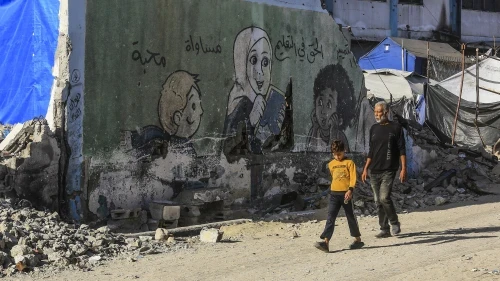
A Palestinian man and boy walk among the rubble of destroyed buildings in Khan Yunis, in the southern Gaza Strip, on Oct. 21, 2025. Photo courtesy of Abed Rahim Khatib/Flash90.
Analysts have dissected U.S. President Donald Trump’s Gaza peace plan and rightly focused on the doubtful prospect that Hamas will disarm as the most obvious reason it could fail. But perhaps a more serious danger lies in what the plan leaves unaddressed: Palestinian education.
School reform
The plan calls for the “deradicalization” of Gaza and for changing Palestinian “mindsets and narratives,” but it doesn’t explicitly mandate reform of schools, curricula or teacher training. That is a glaring omission.
Trump—or, more likely, the plan’s principal architect, his son-in-law and adviser on the Middle East Jared Kushner—understood this in the first term. That administration’s 2020 “Peace to Prosperity” plan explicitly called for reform of Palestinian education. Eliminating incitement, the glorification of terrorism and the denial of Israel’s right to exist from Palestinian schools was part of the peace framework. More importantly, reform of curricula and textbooks was made a condition for Palestinian statehood.
“Gotta be taught to hate”
That requirement reflected a basic truth that much of the international community has spent decades avoiding: You cannot educate children for conflict and expect them to grow up committed to peace. The governments that have recognized a Palestinian state have ignored this contradiction.
Diplomats and peace advocates treat Palestinian educational incitement as a peripheral issue, if they acknowledge it at all. Israelis do not have that luxury. They know what Palestinian children are taught. When Palestinian textbooks omit Israel from maps, Israelis do not regard that as an academic oversight; they see it as evidence that the goal remains a Palestinian state replacing Israel rather than living beside it. Oct. 7 made those fears impossible to dismiss.
Israelis have complained to donor governments for decades but failed to persuade them to exert pressure on Hamas, the Palestinian Authority and the U.N. Relief and Works Agency for Palestine Refugees (UNRWA) to change what children are taught. European governments continued financing P.A. and UNRWA education even after the E.U.-funded Georg Eckert Institute concluded in 2021 that Palestinian textbooks contained anti-Semitic narratives, glorifications of violence and dehumanizing portrayals of Israelis.
ADVERTISEMENT
Persistent problem
The European Union and individual member states have since periodically condemned problematic educational content and threatened to condition aid on reform, but the money has continued to flow to UNRWA and P.A. teachers.
Predictably, the problem has persisted.
In its review of the P.A.’s 2025-26 educational materials, IMPACT-se found recurring themes across subjects that included the promotion of jihad and martyrdom; glorification of terrorism and violence; anti-Semitic incitement; rejection of peacemaking; and the erasure of Israel from maps.
Nor were these messages confined to history or religious studies. Political messages and references to violence appeared in subjects such as mathematics and science. Language materials and teacher guides portrayed armed struggle favorably and presented individuals responsible for deadly attacks on civilians as role models.
Oct. 7 massacre in curriculum
Palestine Media Watch recently documented an even more disturbing phenomenon: schools incorporating the Oct. 7 massacre into lessons and activities.
In one third-grade mathematics assignment, students were instructed: “Create a verbal math question based on the war in Gaza, using 9 × 150.” Several students submitted examples like this one: “[Hamas’s] Al-Qassam Brigades sent 150 Jihad fighters to [each of] nine settlements [i.e., Jewish towns] in Israel. How many jihad fighters entered the settlements?”
“Answer: 1,350 jihad fighters.”
The teacher’s response was not to correct the glorification of an attack on civilians but to praise the child: “May Allah protect you, champion! Victory to the residents of Gaza!”
Schools also held assemblies at which children recited poems and delivered presentations celebrating the slaughter of 1,200 men, women and children. The gist of them can be gleaned from a girl in elementary school who declared: “On Saturday [Oct. 7], the people who resist returned to their land. … It was impossible to express the emotions in our hearts, and we never imagined such pride in our people on our faces. The sense of honor that we felt is indescribable.”
Intervention?
To Israeli ears, such words sound like an echo of Hamas leaders who vowed to repeat Oct. 7 “again and again.” When that message is instilled in children, the threat is not merely to repeat the massacre tomorrow, but to perpetuate the impulse behind it for generations.
The determination to propagate this message was evident when the P.A. created a condensed curriculum for Gaza after the war so students could catch up academically. None of the countries and NGOs involved in the Strip’s renewal intervened.
According to IMPACT-se, instead of taking the opportunity to implement reforms, the shortened material distributed to more than 290,000 Gaza students retained themes involving anti-Semitism; jihad and martyrdom; glorification of violence and terrorism; and demonization of Israel. It continued to include maps erasing Israel and material rejecting Israel’s legitimacy and discouraging peaceful coexistence.
The problem extends beyond textbooks. IMPACT-se also found reopened Gaza schools showing blackboard messages, posters, wall inscriptions, performances and other locally produced material that glorified terrorism, celebrated the Oct. 7 attacks and honored Hamas figures.
ADVERTISEMENT
Invest in peace
Educational reform requires printing new textbooks, changing what teachers teach; what principals permit; what appears on classroom walls and blackboards; what students perform at assemblies; and what educational authorities reward or condemn.
This should be a priority as Trump solicits governments to rebuild Gaza. Billions of dollars will undoubtedly be spent by governments, international organizations and NGOs to reconstruct schools. But rebuilding education must mean more than pouring concrete, replacing desks and reopening classrooms.
Donors should ask themselves a question they largely failed to ask before Oct. 7: “What will be taught inside the schools we are paying to construct?” New facilities without changing what is taught inside them would not be an investment in peace; it would sow the seeds for the next war.
Fundamental truths
The 2020 Trump peace plan therefore offers an important guide for what should happen next. Educational reform should be a condition for international funding and an integral part of any political settlement.
Postwar Gaza needs an education system that helps traumatized children recover, gives them useful skills, allows them to understand Palestinian history and fosters a healthy Palestinian civic identity. None of that requires erasing Palestinian grievances or demanding that Palestinians adopt Israel’s historical narrative.
It does require teaching some fundamental truths: Jews and Israelis are human beings with rights; Judaism is one of the world’s great religions; Jews have a 3,000-year-old connection to the region and the land; Israel is an internationally recognized state that will not disappear or be replaced by Palestine; political grievances do not justify murdering civilians; and Palestinians can pursue dignity and self-determination without denying those same rights to Jews.
Disarming Hamas is necessary, but is insufficient to bring stability, much less peace.
If Hamas’s worldview survives in Gaza’s classrooms, the ideology that fueled Oct. 7 will be passed to another generation. Nor can reform stop at Gaza’s borders. The same lessons of hatred, martyrdom and rejectionism must be rooted out of the P.A. educational system as well.
Originally published at
JNS
ADVERTISEMENT
Why the Gaza plan is doomed to fail
Mitchell Bard argues Trump’s Gaza peace plan overlooks a crucial piece: reforming Palestinian schools that still teach incitement and hatred.
Mitchell Bard
6
mins read time
Originally published at
JNS
A Palestinian man and boy walk among the rubble of destroyed buildings in Khan Yunis, in the southern Gaza Strip, on Oct. 21, 2025. Photo courtesy of Abed Rahim Khatib/Flash90.
Analysts have dissected U.S. President Donald Trump’s Gaza peace plan and rightly focused on the doubtful prospect that Hamas will disarm as the most obvious reason it could fail. But perhaps a more serious danger lies in what the plan leaves unaddressed: Palestinian education.
School reform
The plan calls for the “deradicalization” of Gaza and for changing Palestinian “mindsets and narratives,” but it doesn’t explicitly mandate reform of schools, curricula or teacher training. That is a glaring omission.
Trump—or, more likely, the plan’s principal architect, his son-in-law and adviser on the Middle East Jared Kushner—understood this in the first term. That administration’s 2020 “Peace to Prosperity” plan explicitly called for reform of Palestinian education. Eliminating incitement, the glorification of terrorism and the denial of Israel’s right to exist from Palestinian schools was part of the peace framework. More importantly, reform of curricula and textbooks was made a condition for Palestinian statehood.
“Gotta be taught to hate”
That requirement reflected a basic truth that much of the international community has spent decades avoiding: You cannot educate children for conflict and expect them to grow up committed to peace. The governments that have recognized a Palestinian state have ignored this contradiction.
Diplomats and peace advocates treat Palestinian educational incitement as a peripheral issue, if they acknowledge it at all. Israelis do not have that luxury. They know what Palestinian children are taught. When Palestinian textbooks omit Israel from maps, Israelis do not regard that as an academic oversight; they see it as evidence that the goal remains a Palestinian state replacing Israel rather than living beside it. Oct. 7 made those fears impossible to dismiss.
Israelis have complained to donor governments for decades but failed to persuade them to exert pressure on Hamas, the Palestinian Authority and the U.N. Relief and Works Agency for Palestine Refugees (UNRWA) to change what children are taught. European governments continued financing P.A. and UNRWA education even after the E.U.-funded Georg Eckert Institute concluded in 2021 that Palestinian textbooks contained anti-Semitic narratives, glorifications of violence and dehumanizing portrayals of Israelis.
ADVERTISEMENT
Persistent problem
The European Union and individual member states have since periodically condemned problematic educational content and threatened to condition aid on reform, but the money has continued to flow to UNRWA and P.A. teachers.
Predictably, the problem has persisted.
In its review of the P.A.’s 2025-26 educational materials, IMPACT-se found recurring themes across subjects that included the promotion of jihad and martyrdom; glorification of terrorism and violence; anti-Semitic incitement; rejection of peacemaking; and the erasure of Israel from maps.
Nor were these messages confined to history or religious studies. Political messages and references to violence appeared in subjects such as mathematics and science. Language materials and teacher guides portrayed armed struggle favorably and presented individuals responsible for deadly attacks on civilians as role models.
Oct. 7 massacre in curriculum
Palestine Media Watch recently documented an even more disturbing phenomenon: schools incorporating the Oct. 7 massacre into lessons and activities.
In one third-grade mathematics assignment, students were instructed: “Create a verbal math question based on the war in Gaza, using 9 × 150.” Several students submitted examples like this one: “[Hamas’s] Al-Qassam Brigades sent 150 Jihad fighters to [each of] nine settlements [i.e., Jewish towns] in Israel. How many jihad fighters entered the settlements?”
“Answer: 1,350 jihad fighters.”
The teacher’s response was not to correct the glorification of an attack on civilians but to praise the child: “May Allah protect you, champion! Victory to the residents of Gaza!”
Schools also held assemblies at which children recited poems and delivered presentations celebrating the slaughter of 1,200 men, women and children. The gist of them can be gleaned from a girl in elementary school who declared: “On Saturday [Oct. 7], the people who resist returned to their land. … It was impossible to express the emotions in our hearts, and we never imagined such pride in our people on our faces. The sense of honor that we felt is indescribable.”
Intervention?
To Israeli ears, such words sound like an echo of Hamas leaders who vowed to repeat Oct. 7 “again and again.” When that message is instilled in children, the threat is not merely to repeat the massacre tomorrow, but to perpetuate the impulse behind it for generations.
The determination to propagate this message was evident when the P.A. created a condensed curriculum for Gaza after the war so students could catch up academically. None of the countries and NGOs involved in the Strip’s renewal intervened.
According to IMPACT-se, instead of taking the opportunity to implement reforms, the shortened material distributed to more than 290,000 Gaza students retained themes involving anti-Semitism; jihad and martyrdom; glorification of violence and terrorism; and demonization of Israel. It continued to include maps erasing Israel and material rejecting Israel’s legitimacy and discouraging peaceful coexistence.
The problem extends beyond textbooks. IMPACT-se also found reopened Gaza schools showing blackboard messages, posters, wall inscriptions, performances and other locally produced material that glorified terrorism, celebrated the Oct. 7 attacks and honored Hamas figures.
ADVERTISEMENT
Invest in peace
Educational reform requires printing new textbooks, changing what teachers teach; what principals permit; what appears on classroom walls and blackboards; what students perform at assemblies; and what educational authorities reward or condemn.
This should be a priority as Trump solicits governments to rebuild Gaza. Billions of dollars will undoubtedly be spent by governments, international organizations and NGOs to reconstruct schools. But rebuilding education must mean more than pouring concrete, replacing desks and reopening classrooms.
Donors should ask themselves a question they largely failed to ask before Oct. 7: “What will be taught inside the schools we are paying to construct?” New facilities without changing what is taught inside them would not be an investment in peace; it would sow the seeds for the next war.
Fundamental truths
The 2020 Trump peace plan therefore offers an important guide for what should happen next. Educational reform should be a condition for international funding and an integral part of any political settlement.
Postwar Gaza needs an education system that helps traumatized children recover, gives them useful skills, allows them to understand Palestinian history and fosters a healthy Palestinian civic identity. None of that requires erasing Palestinian grievances or demanding that Palestinians adopt Israel’s historical narrative.
It does require teaching some fundamental truths: Jews and Israelis are human beings with rights; Judaism is one of the world’s great religions; Jews have a 3,000-year-old connection to the region and the land; Israel is an internationally recognized state that will not disappear or be replaced by Palestine; political grievances do not justify murdering civilians; and Palestinians can pursue dignity and self-determination without denying those same rights to Jews.
Disarming Hamas is necessary, but is insufficient to bring stability, much less peace.
If Hamas’s worldview survives in Gaza’s classrooms, the ideology that fueled Oct. 7 will be passed to another generation. Nor can reform stop at Gaza’s borders. The same lessons of hatred, martyrdom and rejectionism must be rooted out of the P.A. educational system as well.
Originally published at
JNS
ADVERTISEMENT
Why the Gaza plan is doomed to fail
Mitchell Bard argues Trump’s Gaza peace plan overlooks a crucial piece: reforming Palestinian schools that still teach incitement and hatred.
Mitchell Bard
6
mins read time
Originally published at
JNS
A Palestinian man and boy walk among the rubble of destroyed buildings in Khan Yunis, in the southern Gaza Strip, on Oct. 21, 2025. Photo courtesy of Abed Rahim Khatib/Flash90.
Analysts have dissected U.S. President Donald Trump’s Gaza peace plan and rightly focused on the doubtful prospect that Hamas will disarm as the most obvious reason it could fail. But perhaps a more serious danger lies in what the plan leaves unaddressed: Palestinian education.
School reform
The plan calls for the “deradicalization” of Gaza and for changing Palestinian “mindsets and narratives,” but it doesn’t explicitly mandate reform of schools, curricula or teacher training. That is a glaring omission.
Trump—or, more likely, the plan’s principal architect, his son-in-law and adviser on the Middle East Jared Kushner—understood this in the first term. That administration’s 2020 “Peace to Prosperity” plan explicitly called for reform of Palestinian education. Eliminating incitement, the glorification of terrorism and the denial of Israel’s right to exist from Palestinian schools was part of the peace framework. More importantly, reform of curricula and textbooks was made a condition for Palestinian statehood.
“Gotta be taught to hate”
That requirement reflected a basic truth that much of the international community has spent decades avoiding: You cannot educate children for conflict and expect them to grow up committed to peace. The governments that have recognized a Palestinian state have ignored this contradiction.
Diplomats and peace advocates treat Palestinian educational incitement as a peripheral issue, if they acknowledge it at all. Israelis do not have that luxury. They know what Palestinian children are taught. When Palestinian textbooks omit Israel from maps, Israelis do not regard that as an academic oversight; they see it as evidence that the goal remains a Palestinian state replacing Israel rather than living beside it. Oct. 7 made those fears impossible to dismiss.
Israelis have complained to donor governments for decades but failed to persuade them to exert pressure on Hamas, the Palestinian Authority and the U.N. Relief and Works Agency for Palestine Refugees (UNRWA) to change what children are taught. European governments continued financing P.A. and UNRWA education even after the E.U.-funded Georg Eckert Institute concluded in 2021 that Palestinian textbooks contained anti-Semitic narratives, glorifications of violence and dehumanizing portrayals of Israelis.
ADVERTISEMENT
Persistent problem
The European Union and individual member states have since periodically condemned problematic educational content and threatened to condition aid on reform, but the money has continued to flow to UNRWA and P.A. teachers.
Predictably, the problem has persisted.
In its review of the P.A.’s 2025-26 educational materials, IMPACT-se found recurring themes across subjects that included the promotion of jihad and martyrdom; glorification of terrorism and violence; anti-Semitic incitement; rejection of peacemaking; and the erasure of Israel from maps.
Nor were these messages confined to history or religious studies. Political messages and references to violence appeared in subjects such as mathematics and science. Language materials and teacher guides portrayed armed struggle favorably and presented individuals responsible for deadly attacks on civilians as role models.
Oct. 7 massacre in curriculum
Palestine Media Watch recently documented an even more disturbing phenomenon: schools incorporating the Oct. 7 massacre into lessons and activities.
In one third-grade mathematics assignment, students were instructed: “Create a verbal math question based on the war in Gaza, using 9 × 150.” Several students submitted examples like this one: “[Hamas’s] Al-Qassam Brigades sent 150 Jihad fighters to [each of] nine settlements [i.e., Jewish towns] in Israel. How many jihad fighters entered the settlements?”
“Answer: 1,350 jihad fighters.”
The teacher’s response was not to correct the glorification of an attack on civilians but to praise the child: “May Allah protect you, champion! Victory to the residents of Gaza!”
Schools also held assemblies at which children recited poems and delivered presentations celebrating the slaughter of 1,200 men, women and children. The gist of them can be gleaned from a girl in elementary school who declared: “On Saturday [Oct. 7], the people who resist returned to their land. … It was impossible to express the emotions in our hearts, and we never imagined such pride in our people on our faces. The sense of honor that we felt is indescribable.”
Intervention?
To Israeli ears, such words sound like an echo of Hamas leaders who vowed to repeat Oct. 7 “again and again.” When that message is instilled in children, the threat is not merely to repeat the massacre tomorrow, but to perpetuate the impulse behind it for generations.
The determination to propagate this message was evident when the P.A. created a condensed curriculum for Gaza after the war so students could catch up academically. None of the countries and NGOs involved in the Strip’s renewal intervened.
According to IMPACT-se, instead of taking the opportunity to implement reforms, the shortened material distributed to more than 290,000 Gaza students retained themes involving anti-Semitism; jihad and martyrdom; glorification of violence and terrorism; and demonization of Israel. It continued to include maps erasing Israel and material rejecting Israel’s legitimacy and discouraging peaceful coexistence.
The problem extends beyond textbooks. IMPACT-se also found reopened Gaza schools showing blackboard messages, posters, wall inscriptions, performances and other locally produced material that glorified terrorism, celebrated the Oct. 7 attacks and honored Hamas figures.
ADVERTISEMENT
Invest in peace
Educational reform requires printing new textbooks, changing what teachers teach; what principals permit; what appears on classroom walls and blackboards; what students perform at assemblies; and what educational authorities reward or condemn.
This should be a priority as Trump solicits governments to rebuild Gaza. Billions of dollars will undoubtedly be spent by governments, international organizations and NGOs to reconstruct schools. But rebuilding education must mean more than pouring concrete, replacing desks and reopening classrooms.
Donors should ask themselves a question they largely failed to ask before Oct. 7: “What will be taught inside the schools we are paying to construct?” New facilities without changing what is taught inside them would not be an investment in peace; it would sow the seeds for the next war.
Fundamental truths
The 2020 Trump peace plan therefore offers an important guide for what should happen next. Educational reform should be a condition for international funding and an integral part of any political settlement.
Postwar Gaza needs an education system that helps traumatized children recover, gives them useful skills, allows them to understand Palestinian history and fosters a healthy Palestinian civic identity. None of that requires erasing Palestinian grievances or demanding that Palestinians adopt Israel’s historical narrative.
It does require teaching some fundamental truths: Jews and Israelis are human beings with rights; Judaism is one of the world’s great religions; Jews have a 3,000-year-old connection to the region and the land; Israel is an internationally recognized state that will not disappear or be replaced by Palestine; political grievances do not justify murdering civilians; and Palestinians can pursue dignity and self-determination without denying those same rights to Jews.
Disarming Hamas is necessary, but is insufficient to bring stability, much less peace.
If Hamas’s worldview survives in Gaza’s classrooms, the ideology that fueled Oct. 7 will be passed to another generation. Nor can reform stop at Gaza’s borders. The same lessons of hatred, martyrdom and rejectionism must be rooted out of the P.A. educational system as well.
Originally published at
JNS
ADVERTISEMENT
Why the Gaza plan is doomed to fail
Mitchell Bard argues Trump’s Gaza peace plan overlooks a crucial piece: reforming Palestinian schools that still teach incitement and hatred.
Mitchell Bard
6
mins read time
Originally published at
JNS
A Palestinian man and boy walk among the rubble of destroyed buildings in Khan Yunis, in the southern Gaza Strip, on Oct. 21, 2025. Photo courtesy of Abed Rahim Khatib/Flash90.
Analysts have dissected U.S. President Donald Trump’s Gaza peace plan and rightly focused on the doubtful prospect that Hamas will disarm as the most obvious reason it could fail. But perhaps a more serious danger lies in what the plan leaves unaddressed: Palestinian education.
School reform
The plan calls for the “deradicalization” of Gaza and for changing Palestinian “mindsets and narratives,” but it doesn’t explicitly mandate reform of schools, curricula or teacher training. That is a glaring omission.
Trump—or, more likely, the plan’s principal architect, his son-in-law and adviser on the Middle East Jared Kushner—understood this in the first term. That administration’s 2020 “Peace to Prosperity” plan explicitly called for reform of Palestinian education. Eliminating incitement, the glorification of terrorism and the denial of Israel’s right to exist from Palestinian schools was part of the peace framework. More importantly, reform of curricula and textbooks was made a condition for Palestinian statehood.
“Gotta be taught to hate”
That requirement reflected a basic truth that much of the international community has spent decades avoiding: You cannot educate children for conflict and expect them to grow up committed to peace. The governments that have recognized a Palestinian state have ignored this contradiction.
Diplomats and peace advocates treat Palestinian educational incitement as a peripheral issue, if they acknowledge it at all. Israelis do not have that luxury. They know what Palestinian children are taught. When Palestinian textbooks omit Israel from maps, Israelis do not regard that as an academic oversight; they see it as evidence that the goal remains a Palestinian state replacing Israel rather than living beside it. Oct. 7 made those fears impossible to dismiss.
Israelis have complained to donor governments for decades but failed to persuade them to exert pressure on Hamas, the Palestinian Authority and the U.N. Relief and Works Agency for Palestine Refugees (UNRWA) to change what children are taught. European governments continued financing P.A. and UNRWA education even after the E.U.-funded Georg Eckert Institute concluded in 2021 that Palestinian textbooks contained anti-Semitic narratives, glorifications of violence and dehumanizing portrayals of Israelis.
ADVERTISEMENT
Persistent problem
The European Union and individual member states have since periodically condemned problematic educational content and threatened to condition aid on reform, but the money has continued to flow to UNRWA and P.A. teachers.
Predictably, the problem has persisted.
In its review of the P.A.’s 2025-26 educational materials, IMPACT-se found recurring themes across subjects that included the promotion of jihad and martyrdom; glorification of terrorism and violence; anti-Semitic incitement; rejection of peacemaking; and the erasure of Israel from maps.
Nor were these messages confined to history or religious studies. Political messages and references to violence appeared in subjects such as mathematics and science. Language materials and teacher guides portrayed armed struggle favorably and presented individuals responsible for deadly attacks on civilians as role models.
Oct. 7 massacre in curriculum
Palestine Media Watch recently documented an even more disturbing phenomenon: schools incorporating the Oct. 7 massacre into lessons and activities.
In one third-grade mathematics assignment, students were instructed: “Create a verbal math question based on the war in Gaza, using 9 × 150.” Several students submitted examples like this one: “[Hamas’s] Al-Qassam Brigades sent 150 Jihad fighters to [each of] nine settlements [i.e., Jewish towns] in Israel. How many jihad fighters entered the settlements?”
“Answer: 1,350 jihad fighters.”
The teacher’s response was not to correct the glorification of an attack on civilians but to praise the child: “May Allah protect you, champion! Victory to the residents of Gaza!”
Schools also held assemblies at which children recited poems and delivered presentations celebrating the slaughter of 1,200 men, women and children. The gist of them can be gleaned from a girl in elementary school who declared: “On Saturday [Oct. 7], the people who resist returned to their land. … It was impossible to express the emotions in our hearts, and we never imagined such pride in our people on our faces. The sense of honor that we felt is indescribable.”
Intervention?
To Israeli ears, such words sound like an echo of Hamas leaders who vowed to repeat Oct. 7 “again and again.” When that message is instilled in children, the threat is not merely to repeat the massacre tomorrow, but to perpetuate the impulse behind it for generations.
The determination to propagate this message was evident when the P.A. created a condensed curriculum for Gaza after the war so students could catch up academically. None of the countries and NGOs involved in the Strip’s renewal intervened.
According to IMPACT-se, instead of taking the opportunity to implement reforms, the shortened material distributed to more than 290,000 Gaza students retained themes involving anti-Semitism; jihad and martyrdom; glorification of violence and terrorism; and demonization of Israel. It continued to include maps erasing Israel and material rejecting Israel’s legitimacy and discouraging peaceful coexistence.
The problem extends beyond textbooks. IMPACT-se also found reopened Gaza schools showing blackboard messages, posters, wall inscriptions, performances and other locally produced material that glorified terrorism, celebrated the Oct. 7 attacks and honored Hamas figures.
ADVERTISEMENT
Invest in peace
Educational reform requires printing new textbooks, changing what teachers teach; what principals permit; what appears on classroom walls and blackboards; what students perform at assemblies; and what educational authorities reward or condemn.
This should be a priority as Trump solicits governments to rebuild Gaza. Billions of dollars will undoubtedly be spent by governments, international organizations and NGOs to reconstruct schools. But rebuilding education must mean more than pouring concrete, replacing desks and reopening classrooms.
Donors should ask themselves a question they largely failed to ask before Oct. 7: “What will be taught inside the schools we are paying to construct?” New facilities without changing what is taught inside them would not be an investment in peace; it would sow the seeds for the next war.
Fundamental truths
The 2020 Trump peace plan therefore offers an important guide for what should happen next. Educational reform should be a condition for international funding and an integral part of any political settlement.
Postwar Gaza needs an education system that helps traumatized children recover, gives them useful skills, allows them to understand Palestinian history and fosters a healthy Palestinian civic identity. None of that requires erasing Palestinian grievances or demanding that Palestinians adopt Israel’s historical narrative.
It does require teaching some fundamental truths: Jews and Israelis are human beings with rights; Judaism is one of the world’s great religions; Jews have a 3,000-year-old connection to the region and the land; Israel is an internationally recognized state that will not disappear or be replaced by Palestine; political grievances do not justify murdering civilians; and Palestinians can pursue dignity and self-determination without denying those same rights to Jews.
Disarming Hamas is necessary, but is insufficient to bring stability, much less peace.
If Hamas’s worldview survives in Gaza’s classrooms, the ideology that fueled Oct. 7 will be passed to another generation. Nor can reform stop at Gaza’s borders. The same lessons of hatred, martyrdom and rejectionism must be rooted out of the P.A. educational system as well.
Originally published at
JNS
ADVERTISEMENT
Related News

Opinions
Columns
Heroic Israelis avert a tragedy in the sky
A columnist argues that ordinary Israelis and a relief crew foiled a suspected suicide hijacking, and that the skies remain dangerous.
Fiamma Nirenstein
October 1, 2026

Opinions
Columns
Let us bask in the glory of our accomplishments
Mitchell Bard argues it’s time to stop debating Zionism and treat its success as settled, not something to keep defending.
Mitchell Bard
September 17, 2026

Opinions
Columns
Get out your crystal ball! Take the 5787 Jewish pundit quiz
JNS columnist Jonathan S. Tobin reviews last year’s picks and previews the new Jewish year with his annual Rosh Hashanah pundit quiz.
Jonathan S. Tobin
September 17, 2026
Opinions
Columns
Heroic Israelis avert a tragedy in the sky
A columnist argues that ordinary Israelis and a relief crew foiled a suspected suicide hijacking, and that the skies remain dangerous.
Fiamma Nirenstein
October 1, 2026
Opinions
Columns
Let us bask in the glory of our accomplishments
Mitchell Bard argues it’s time to stop debating Zionism and treat its success as settled, not something to keep defending.
Mitchell Bard
September 17, 2026
Opinions
Columns
Get out your crystal ball! Take the 5787 Jewish pundit quiz
JNS columnist Jonathan S. Tobin reviews last year’s picks and previews the new Jewish year with his annual Rosh Hashanah pundit quiz.
Jonathan S. Tobin
September 17, 2026

Opinions
Religion & Philosophy
Who am I, really?
Rabbi Yossy Goldman on what makes Yom Kippur uniquely powerful and why it reveals who we really are.
Rabbi Yossy Goldman
September 16, 2026

© 2026 The Jewish World · Since 1965 - The Capital Region's gateway to Jewish life
Designed and Developed by Ta-Da Studios
© 2026 The Jewish World · Since 1965 - The Capital Region's gateway to Jewish life
Designed and Developed by Ta-Da Studios
© 2026 The Jewish World · Since 1965 - The Capital Region's gateway to Jewish life
Designed and Developed by Ta-Da Studios
© 2026 The Jewish World · Since 1965 - The Capital Region's gateway to Jewish life
Designed and Developed by Ta-Da Studios